Raise the Hammer

Hamilton City Council has the choice to be global leaders and ban drive-thrus.
By Trey Shaughnessy
Published May 16, 2005
I have a challenge for the Hamilton City Councillors.
There are two kinds of cities - cities that lead and cities that lag. Cities that lead are progressive. Cities that lead are the first to do something in order to make changes.
In 1990, San Luis Obispo, California became the first city in the world to ban smoking in all public buildings including bars and restaurants. Since that time, municipalities around the world have followed suit, using San Luis Obispo as a model.
I'm sure you are aware that cities from Vancouver to Hamilton have adopted smoking bans in public workplaces, bars and restaurants or are in the process of doing so—lagging behind. Every time a city wrestled with the ban, the same concerns were raised, it would put restaurants out of business, keep tourists away, lower tax revenues, and cost jobs. And every time a city implemented the ban the reverse was true.
In 1990, Winnipeg became the first Canadian city to ban Pitbulls. Other cities are following their example.
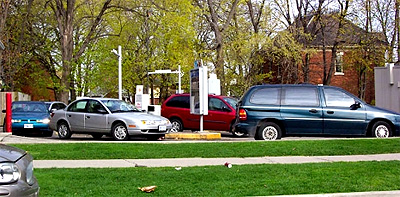
Congestion in drive-thru lanes is no idle matter.
By 2001, Toronto, Calgary, Vancouver, Waterloo, Ont. and nine other municipalities in Quebec had passed by-laws that restricted or banned the use of pesticides on lawns for cosmetic reasons, following the example of Halifax.
In 2003, London England imposed a daily £5 ($11 Cdn) toll for cars to drive downtown (the zone). London's Mayor, Ken Livingstone, said major road-building plans to ease congestion would be financially and environmentally "unacceptable", and he predicted that 'congestion charging' would cut traffic in central London by 15 per cent.
Opponents say it will put further pressure on London's overcrowded buses and creaking Underground as thousands of motorists abandon their cars for public transport. It was expected tolls would be reinvested into public transit.
Mayor Livingstone acknowledged the charge was a political gamble, "but what's the point of being in politics if you don't do something with your position?" he told British TV viewers.
A year later it is reported that, public transport has coped with ease. Around 29,000 additional bus passengers are entering the zone on 560 extra bus services in the morning peak period. Average bus speeds have increased by seven percent and cycling has increased by a third inside the zone.
Congestion charging has worked so well that San Francisco is currently studying a similar plan for its downtown. Jake McGoldrick, chair of the San Francisco Transportation Authority told the San Francisco Examiner, "The key issue here is if we can kill three birds with one stone — relieve congestion, clean up the air, and give money to MUNI (its HSR) — we would have hit a home run."
Last summer Paris drew-up plans that would ban SUVs when air pollution is high. The city's deputy mayor for transportation, Denis Baupin, wants mud-pluggers off the streets permanently. "We have no interest in having SUVs in the city. They're dangerous to others and take up too much space," he said on Europe 1 radio. [See also: Just Passing Through - Ed.]
If Paris officials are successful, similar bans could follow in other cities - including London, where mayor Ken Livingstone recently referred to urban drivers as "idiots".
"For decades, cities have been built for cars...we can't let things get out of control when we are close to asphyxia," France's transport minister Jean-Claude Gayssot told the daily Le Monde.
Does anyone notice a pattern?
Typically, when I read about governments imposing 'bans' on this and that, my reaction is to launch into a diatribe soliloquy about how government should stay out of our lives. That's my right (wing) brain talking.
Then my left (wing) brain thinks about it and comes to this conclusion. These 'bans' benefit our emotional and physical health, our urban and natural environment, our safety and well-being.
These 'bans' don't infringe on anyone's rights; rather, they protect us from what Ted Mitchell false freedoms: practices that "cause significant harm or restriction of the rights and freedoms of other individuals."
What could be wrong with that? Hospitals have adopted "scent-free" policies, airlines and hospitals ban cell phones, schools ban peanut butter. All these things are to improve everyone's quality of life.
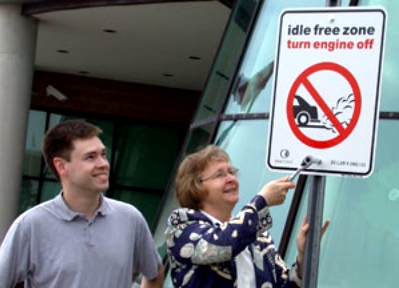
The Town of Oakville kicked off its 2004 Anti-Idling education campaign with Mayor Mulvale and Councillor Adams.
Currently, Hamilton city council is considering an anti-idling by-law, following the lead of many cities — Toronto (1996), London (1999), Burlington, Brampton, Windsor, Markham, Oakville, Pickering, Peterbough, Welland, Mississauga, and Sudbury - most limitimg idling to less than three minutes.
It seems that we are on-track to be the last city - lagging. Don't worry; I have an idea that will make up for our lagging.
Now for my challenge for Hamilton City Council: Ban drive-thrus.
Think about it. Who would have thought the aforementioned bans would ever have happened? Besides, drive-thrus are getting a bad reputation for smog, adding to obesity, facilitating social isolation, road rage, noise, and polluting neighbours.
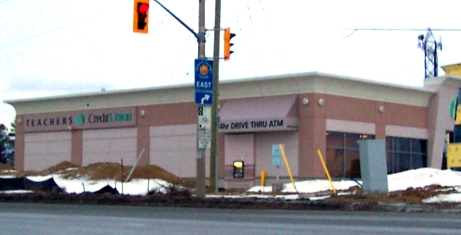
It's already difficult to walk anywhere. Wrapping buildings with drive-thru lanes further isolates would-be pedestrians and reinforces driving.
Recent news out of the U.S. criticized Starbucks for adding to the traffic congestion in the morning.
Everyone knows how much more careful you have to drive when you pass a Tim Horton's drive-thru. Just this morning, a colleague told me about an accident at a Mississauga Tim Horton's, where a school bus crashed into a car leaving a drive-thru.
If you drive past the Kenilworth Avenue Tim Horton's in the morning, traffic is often overflowing onto Kenilworth, effectively turning the curb lane into an extension of its drive-thru queue.
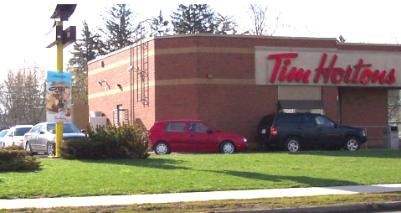
Are drive-thrus able to serve everyone in less than three minutes? If not, they will be in violation of an anti-idling by-law. Will the city enforce anti-idling at drive-thrus?
By the way, what does an anti-idling bylaw mean to drive-thrus? Does this make drive-thrus illegal? It does, unless the drive-thru serves everyone within three minutes.
If a ban is too "progressive," then how about at least a moratorium or a temporary drive-thru shut-down during "smog days"? After all, we are encouraged not to cut our grass when air quality is poor.
Hamilton was the first city in Canada to have a car drive on its roads. Let's make a new Hamilton first for Canada, one that would make Hamilton a leader, one that would give Hamilton that "branding" we are trying to achieve, one that would say to the world, "Follow our lead," just like London, Paris, Winnipeg, Halifax, San Francisco, San Luis Obispo, and other cities have done in recent years.
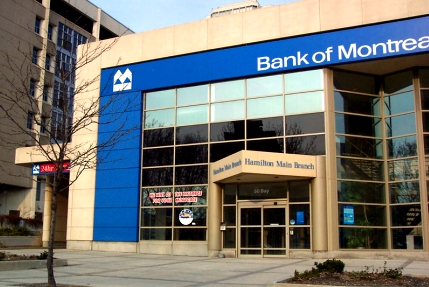
Banks and fast food and now the LCBO are the largest drive-thru users. Are they really necessary and at what cost?
Do we want to be leaders or laggards? Trust me, banning of drive-thrus will happen. If it doesn't happen in Hamilton first, it will soon happen in another progressive city and we will drag ourselves along.
So come on, Hamilton Councillors, remember the words of London's mayor: "What's the point of being in politics if you don't do something with your position?" Ban drive-thrus in Hamilton.
By Steeltown (registered) | Posted None at
Aw that means you would ban Fast Eddie's. Just kidding lol. It's a good idea. But doesn't Mississauga already take a leading rold in banning drive-thrus?
By urbananimal (registered) | Posted None at
Winnipeg's pit bull ban was hardly a step forward. True people did follow, but it was a lead born of ignorance and fear and is hardly a selling point for your argument. It is sad to see that there are those who think an attempt to eradicate an animal is progressive.
By adrian (registered) | Posted None at
I agree that Hamilton ought to take initiative and be a leader, and I also believe promoting environmentally-friendly practices is important. But I think implementing your idea would have some pitfalls and some unintended consequences. Businesses that rely on drive-thrus to serve many customers would require more parking to serve the same number of customers without a drive-thru - I'm sure creating more and larger parking lots is not what you intended. It would also have significant costs for businesses beyond the expense of altering or removing the drive-thru structure - for example, businesses that rely on a drive-thru to serve many customers without a space for parking would suffer greatly if they were forced to remove it. Your comment about obesity is also a little misplaced, as your picture of the Bank of Montreal drive-thru shows. Since many of your concerns relate to pollution and noise, a ban on idling would probably accomplish a lot. As for the congestion on some city streets (the Tim Horton's at Wellington & King is another great example), I'm not really sure what could be done. If people were forced to park, it would probably be even worse. The real problem is really our dependence on cars, as a previous article here pointed out. But there's another initiative that Hamilton could take that also makes sense as the birthplace of Tim Horton's and it relates to many of the businesses that have drive-thrus: a tax on disposable containers, like the cardboard Tim Horton's cups you see littered all across the city. Why can't we move to a system of reusable containers, perhaps even install dishwashers in these places along with an exchange program for the cups?
By Trey (registered) | Posted None at
Keep Rover on a leash Jun, 02 2005 - 5:00 AM HAMILTON (AM900 CHML) - Dog owners are being warned to keep fido on a leash while walking the trails belonging the Hamilton Conservation Authority. Since March, six people on the trails have been bitten by dogs while others have been chased or knocked off their bicycles. So the conservation authority has launched a crackdown by hiring off-duty police officers and animal control officials to patrol the trail systems looking for dogs running free. It could cost the owner 120-bucks.
By t__thinker16 (registered) | Posted None at
Hi! I just wanted to say that I agree with everything in your article, it's all pretty much common sense, but I fail to see the link between smoking, drive-thrus, and pit-bulls. I am father of four children aged 1-7. We have a 3year old pit-bull we've had since she was a pup. She has never tried to hurt any of our kids, they can hang from her ears and she drags em around the house playing with them. The most likely dogs to "snap" are golden retrievers and cocker spaniels. Some people make their dogs mean and fight them and they should be punished. Our dog has been raised to be friendly but at the same time if anyone would break-in or try to hurt any of us she would tear them a new #@!, with about a 2,000 psi bite:)
By Trey (registered) | Posted None at
The connection is common decency. People need to have respect for other peoples health, safety and well being, especially if it is behaviour that is within their control.
By commuter (anonymous) | Posted December 29, 2006 at 23:08:09
Is there not a traffic law that says you can't block city lanes during rush hour? Where are the police? Oh right....
I think Horton's are the worst since they now build parking free "kiosks" and let the public streets handle the traffic. I say stop those first. Or Horton's needs to speed up like fast-food which us usually less of a problem.
commuter
By Pertz (anonymous) | Posted January 10, 2007 at 00:04:06
Two simple solutions that will work:
1. Have a plain clothes ticketer stand in front of the worst Tim Horton's (Main by Dundurn comes to mind) on random days throughout the month.
2. Have every drive-through modify itself so cars can coast down it. It really wouldn't cost that much in the grand scheme of things, as only a slight angle is needed. Brakes still work with the car off.
By enviro-freak (anonymous) | Posted February 11, 2007 at 14:58:21
I am currently working on a project studying idling times at fast-food locations and i am planning to propose the idea of banning drive-thru's all together. Forget banning idling in drive-thru's, just cut the whole thing out. No wonder our country's obesiety rates keep rising, everyone is too lazy to get out of their cars and save time by taking a few extra steps. This may not be the ultimate step to preventing global warming, but it sure will help slow it down.
By enviro-freak (anonymous) | Posted February 11, 2007 at 15:04:11
After reading Adrian's comments about having to take out drive-thru's if they were banned, there is a simple solution, turn those areas into extra parking spaces. The only problem with this is that every-one would leave their vehicles idling in the parking lot. This would have to stop, and maybe (im not encouraging this) if their vehicles were stolen, these people would learn their lesson.
By Blindmonkey (anonymous) | Posted May 28, 2007 at 13:30:08
I choose not to drive and have never learned how but I think the drive thru concept is worth saving. Perhaps when a car enters the drive thru section they could drive onto a giant wheel or conveyor belt that allows (requires) the cars to turn off completely and be automatically advanced with the pace of service.
I do think there should be limited permits given for drive thrus.
You mean like a hamster wheel? Wouldn't it fall off when it got to the top?
Just wondering
By tigercat (anonymous) | Posted May 28, 2007 at 18:38:55
Yes, ban drive throughs...all of them. Not only will it help the air but it will cut down on all the garbage left in the streets and tossed out of car windows. If we had one cent for all the tim horton coffee cups left blowing in the wind...we could do alot to fix up downtown. Plus, the other side of the ban means people will get a little exercise by getting their butts out of the car and walking a few steps. Its a win win all the way around.
By capiitalist (anonymous) | Posted July 11, 2007 at 15:21:53
Banning rive thrus would be a horrible intrusion on freedom. Instead charge more for gas. Why do you get to decide that your car trip to whereever is more important than my coffee? All gasoline pollutes equally. Tax it all and ban no gasoline use.
By seancb (registered) - website | Posted July 12, 2007 at 12:37:24
Same reason we all (through elected officials) get to decide what safe speed limit to post and what days we are allowed to water gardens during a drought -- to create benefits for all even if it means inconveniencing a few.
Coffee is a convenience. Breathing is a necessity.
By Thinker (anonymous) | Posted August 17, 2007 at 10:59:47
Would the 'drive thrus' begin to install car wash like conveyors?
That is you turn the car off, put it in neutral and then just conveyor on along until you are done?
How about that option. They really are not idling.
It would be a bit of a hassle but could be hassle free depending on how much thought they put into it.
By Thinker (anonymous) | Posted August 17, 2007 at 11:07:07
What about when all cars are hydrogen or fuel cell cars and apparently the only by-product of idling is pure water?
Will drive thrus then become legal again?
What about if I by a hybrid vehicle, which I am currently considering. I think I will just be running on the batteries while in a drive thru. No pollution per say.
Maybe they should make drive thrus allowable for hybrid vehicles only?
Maybe that will get more people to buy hybrid vehicles. Maybe that will do 10x more to reduce pollution?
That's alot of maybes. LOL.
By Thinker (anonymous) | Posted August 17, 2007 at 11:11:41
The drive through slope is an interesting idea and I now see the conveyor idea was also mentioned. Either way, costs are involved and every user friendliness may be compromised.
By Thinker (anonymous) | Posted August 17, 2007 at 14:07:09
The drive through slope is an interesting idea and I now see the conveyor idea was also mentioned. Either way, costs are involved and every user friendliness may be compromised.
By trey (registered) | Posted August 22, 2007 at 10:25:55
wrt a conveyor belt.
Something has to power the conveyor belt and the energy needed to power it will create an exhaust.
The fumes are not the only thing wrong with drive thrus. They also ruin the street, cause accidents and make it more difficult to enter/exit for pedestrians. Take the Concession street Tim Hortons, it completely put a 'missing tooth' in the streetwall in order to have its drive thru and mandated surface parking lot. The street basically ends at that Tim Hortons.
Please distribute and & wide!!!
Dear Friends,
I have just read and signed the petition: "Ban Drive-Throughs in Canada"
Please take a moment to read about this important issue, and join me in signing the petition. It takes just 30 seconds, but can truly make a difference. We are trying to reach 50,000 signatures - please sign here: http://www.thepetitionsite.com/takeactio...
Once you have signed, you can help even more by asking your friends and family to sign as well.
Thank you!
Council of Canadians - London Chapter
By mitzy509 (anonymous) | Posted February 04, 2008 at 16:15:37
First I have to say, I hope none of the above commenters use any Drive-thrus, afterall it would be hypocritical.
After reading the article and the comments, I am annoyed that City Coucil and commenters are not taking into consideration how many people will be out of employment. Tim Hortons, Starbucks, and all other companies that hire people to run their Drive-thrus would have to lay-off a considerable number people. Are you prepared to find jobs for all of these individuals? As an employee of one of these franchises, I know that this puts 6-10 full-time employees per store out of a job. The town in which I am employed has 12 stores, that I know. Do the math. That is one franchise to speak of. I also know the stores I work for are doing their part to keep Drive-thru times down. The average time customers are served at our store between 6am and 10am is 21 - 25 seconds. Now would it be fair to ban all Drive-thrus and unemploy 72-120 full-time individuals?
I do feel that we should get rid automated Drive-thru services like bank machines but I will not be signing your petition. I don't feel like City Council has given this topic enough thought.
Thank You!
Concerner Citizen
By trey (registered) | Posted February 07, 2008 at 10:25:15
Laying off a few dozen minimum wage workers? O help us, how will we ever get through that?
Where were you (your objection) when government policies like free-trade and endorsing slave labour practices in developing countries resulted in closing Camco and the hundreds of thousands of HIGH PAYING jobs were elimated.
By Mitzy509 (anonymous) | Posted February 15, 2008 at 17:22:36
Are you kidding Trey? First of all, you're ok with MORE people being laid-off because HIGH PAID camco people were!?! That's logical. And you actually believe it's only a few dozen min. wage indviduals? The above stats only represent one franchise in one SMALL area. Let me ask you, is your job at risk? You think I don't know that I can get another job? I happen to enjoy my job and I'm very good at it. Why should my job be at risk because a bunch of tree huggers from Hamilton, of all places, thinks that my franchise is killing the environment. Do you drive? Do you wait in traffic and at red lights or take road trips? Do you turn your vehicle off in -18c when you run in to get your coffee?
And to the genius with the cup exchange idea, have you heard of travel mugs. And why is it you feel fast food owners should be responsible for people putting garbage in its place. Some people are just ignorant and are going to litter, whether it be a Tim Horton's cup or a package from a snack they brought from home. Actually most people are so ignorant.
By Trey (registered) | Posted February 16, 2008 at 12:20:57
Interesting.... Tim Hortons has decided to close the store at Dundurn and Aberdeen. They claim "it's too old". I guess it can't be retrofitted? A cinderblock, flat roof box is too old. For what exactly?
I'll take a wild guess why. IT CAN'T ACCOMMODATE A DRIVE THRU. so it's closing.
I hope Starbucks or Second Cup locates there.
By Trey (registered) | Posted February 16, 2008 at 12:26:55
If we close the drive thrus then customers will just have to walk into the store. Who says there would be layoffs? Simple supply and demand would dictate that the same drive thru customers would still buy coffee and you'd need more inside staff..... just like 25 years ago.
Or would people decide to give up coffee just because they couldn't use a drive thru to purchase? I don't think so.
By Mark (registered) | Posted February 28, 2008 at 16:43:28
There's a Starbucks opening on Locke Street. I bet the owner that is closing the Aberdeen/Dundurn Tims is the one opening the Starbucks.
By desantis (anonymous) | Posted March 24, 2008 at 21:50:51
even Terry Cooke has commented about this in The Spec. He said the same thing, that the reason for the closure is likely the inability to install a drive-thru.
By TreyS (registered) | Posted February 23, 2009 at 13:30:29
How long until McQuinty passes the Province wide-ban? Just like pesticides.
Leaving to lame municipalities is a bad idea. Imagine two Tim Hortons on Burloak Rd. One on the Oakville side the other on Burlington's. And then Oakville passes a drive-thru ban.
The ban needs to be a province wide initiative. Plus Municipal councils are too weak and are on a constant election campaign to pass anything as progressive as this.
By wondering (anonymous) | Posted February 25, 2009 at 10:25:39
of all the things horribly wrong with our city-province-country-world you are putting your efforts into closing drive thrus?
most people like drive-thrus for some of us who have physical limitations they are a blessing
get a grip
better yet get a life
By not wondering (anonymous) | Posted February 25, 2009 at 14:00:31
your right wondering, everyone should only focus on whatever you think is the biggest problem. Things would be so much easier that way wouldn't they?
By TreyS (registered) | Posted February 25, 2009 at 15:45:27
I would argue, that this issue has become front and center and of importance to many people. I'm judging this on the fact that this article has had lots of attention, from TV news programs, Council of Canadians, and the subject of many newspaper articles.
I appreciate your opinion and my intention was to develop a conversation around this issue.
You must be logged in to comment.
There are no upcoming events right now.
Why not post one?