Raise the Hammer

Joel Hirschhorn spreads the word about the dangers of sprawl and encourages people to demand healthy places to live.
By Ryan McGreal
Published September 15, 2005
I don't like to exercise. I never have. There was one summer when I managed to jog every day (and actually sort of enjoyed it), but that was fifteen years ago.
Fitness centre business models depend on people who share my attitude toward exercise. Drive on down to the gym, pay your three-month membership up front, and make a solemn vow never to return.
If exercising was the only way I ever got exercise, I would be 400 pounds right now.
Fortunately, I live in a dense, hundred-year-old neighbourhood adjacent to downtown Hamilton. Walking five minutes in one direction takes me to a network of woodland trails; five minutes in the other takes me to a business district with an organic grocer, a bakery, a deli, a neighbourhood library branch, and a number of galleries and antique dealers.
I walk (or bicycle) to work, local stores, the park, and my son's school to pick him up. It's not exercise - it's transportation, and that makes all the difference.
My daily commute (five minutes each way by bicycle, or twenty minutes on foot) compares favourably with most automotive commutes. It's also more convenient and vastly less expensive than driving.
I've even mastered the art of reading while walking. It probably looks dorky, but this form of multitasking is less stressful and dangerous than talking on a cellphone while driving, and less absurd than watching TV while riding a stationary bike.
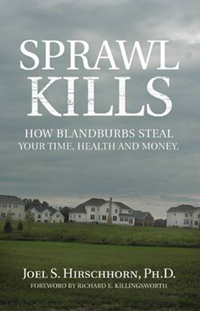
In his new book Sprawl Kills: How Blandburbs Steal Your Time, Health, and Money (Sterling & Ross, 2005), author Joel S. Hirschhorn dispenses with moralistic entreaties to consumers to sacrifice for the common good. Instead, he calls on consumers to demand better homes and neighbourhoods for their own good. (See also: Land Gluttony, by Joel Hirschhorn, in the August 22 issue of RTH.)
Hirschhorn draws a sharp distinction between exercise and what he calls "active living".
Exercise - movement for movement's sake - consumes precious time, requires ongoing will-power, and must often be performed in unfriendly environments: fitness centres, basement workout rooms, or the gravel shoulders of streets with no sidewalks. Most North Americans can't or won't exercise, despite the steady warnings of surgeons-general that lack of regular activity invites obesity, high blood pressure, heart disease, diabetes, and cancer.
Active living, by contrast, does not need to be squeezed in between work, commutes, and other activities. Instead, it serves as the very connective tissue that holds busy lives together: walking to work (or to a nearby train station), walking to the store, cycling to a meeting or appointment, hiking with family and friends through an urban forest, playing in the park.
Hirschhorn documents all the ways that the physical environment of sprawl developments - low-density houses in car-dependent subdivisions, separated from stores and offices and connected by highways - directly affects residents' quality of life, from poorer health to wasted time, much higher transportation and health care expenses, social isolation and impaired development, even premature death.
How does sprawl kill thee? Hirschhorn counts the ways.
He digs deeply into the complex interplay between sprawl land use and poor health, peeling back layer after layer of risk factors and noting the myriad collisions between them:
His conclusion: sprawl kills, literally, by forcing its residents into dangerous lifestyle and transportation arrangements, whereas "healthy places" encourage and support the activities people need to enjoy rich, full lives - free time, social contacts, self-powered transportation, healthy environments, and community engagement.
Unfortunately, as Hirschhorn notes, a huge and influential industry has been built around perpetuating sprawl development, and it uses every propaganda and lobbying resource at its disposal to ensure that zoning regulations, public infrastructure funding, and advertising continue to push sprawl at the expense of healthy places.
Hirschhorn calls its agents "sprawl shills", and he's not afraid to name names or identify tactics. After years working as an advisor to the U.S. National Governors' Association, he has seen their efforts up close, and wants everyone to know what happens in back rooms to manipulate the so-called 'free market' for homebuilding.
People deserve real choice in where to live, but the complex system of highway subsidies, zoning restrictions, unfair tax codes, and underinvestment in transit means that developers make the most money from buying cheap rural land and building large, flimsy houses far from all amenities. As Hirschhorn demonstrates amply, that building pattern is deadly.
My one big complaint about Sprawl Kills is the absence of proper references. In some cases, Hirschhorn refers to reports by name, but in many other cases, he simply claims "a study showed..." or "researchers found..." without citing his sources.
He does provide a bibliography and a long list of web links, but I would have liked to look more deeply into some of his facts and figures. I strongly encourage Hirschhorn and the book's publisher, Sterling & Ross, to include this in the next edition of the book.
Otherwise, Sprawl Kills is a worthy addition to the growing literature on smart growth and new urbanism. He identifies the hidden interests working to perpetuate sprawl, explains in detail why sprawl is bad for its residents, and then shows how to identify - and demand - healthy places instead.You must be logged in to comment.
There are no upcoming events right now.
Why not post one?