Raise the Hammer

As well as trying to change behaviours, we should also arrange our physical environment so the danger of collisions is reduced without sacrificing the pedestrian character of city streets.
By Ryan McGreal
Published August 30, 2006
On Thursday, August 24, 2006, 13-year-old Stephan Clarke was riding his bike down the sidewalk of Glow Avenue. He swerved onto the street to avoid a woman pushing a stroller toward him, jumping off the curb the way children always do. (Who am I kidding? I do it, too.)
Instead of cruising on asphalt, Stephan plowed into a pickup truck and died from the resulting head injury.
People are already discussing the fact that he wasn't wearing a helmet. Maybe that would have saved his life; maybe it would have rendered him comatose or vegetative. It certainly wouldn't have made things worse.
People are also discussing the fact that he was riding on the sidewalk and cut suddenly onto to the road. The first rule of safe cycling is to be visible and predictable so motorists can guess what you're going to do.
A common theme in these responses is that they approach this tragedy as a behaviour problem and focus on what the cyclist should have done.
The trouble is that it's difficult to change people's behaviour. We can make rules and run education campaigns, but change comes slowly, if at all. It's just too much fun to jump the curb; few children can resist the urge.
Instead of scolding his decision to ride on the sidewalk (in fact, children are allowed to ride on the sidewalk) or swerve between the sidewalk and the street, we can ask ourselves: why was it impossible for Stephan Clarke to find a safe place to ride his bicycle in the first place?
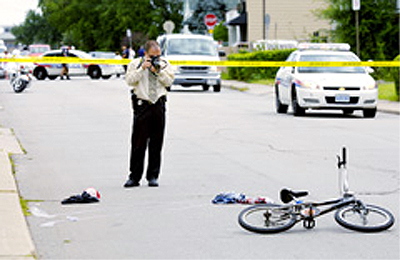
A police officer investigates the fatal cycling collision on Glow Avenue (Photo Credit: Barry Gray, Hamilton Spectator)
Let's regard it as an engineering problem rather than a behaviour problem. When engineers design systems, they try to make them foolproof, meaning safety is inherent to the system's design and does not depend on conforming behaviour.
Obviously, the goal of a completely foolproof street is elusive, but some simple changes would make the fateful street that took Stephan Clarke's life much safer.
Wider Sidewalks - Stephan had to swerve around the oncoming pedestrian because residential sidewalks are very narrow, often less than two metres. If the sidewalk was, say, three or four metres wide, Stephan might not have had to swerve onto the road to get out of the mother's way. The character of urban streets includes wide sidewalks because they allow a more diverse set of people to share the space.
Lower Vehicle Speeds - Below 25 km/h, the fatality rate for vehicle collisions essentially drops to zero. At lower speeds, it's easier to avoid a collision by stopping, and when collisions do occur, they result in less serious injuries.
There are a number of ways to lower vehicle speeds. The most obvious, of course, is simply to lower the speed limit. However, this transforms the engineering problem back into a behavioural problem.
Better still, we can arrange the street so that drivers must go slowly. Glow Avenue, the street where Stephan was killed, is wide, straight, and unimpeded by parked cars or other obstacles. That means drivers can proceed rapidly between Parkdale Ave. and Woodward Ave. With narrower lanes, curbside parking, extended crosswalks, and other traffic calming measures, the realistic top driving speed would drop toward that crucial 25 km/h benchmark.
Bicycle Lanes - I'm not entirely convinced about bicycle lanes, since they create a non-intuitive arrangement at intersections (motor vehicles to the left may turn right across the path of cyclists proceeding straight through). However, a bike lane on Glow Avenue would have provided a margin of space between Stephan and the pickup truck, possibly saving his life.
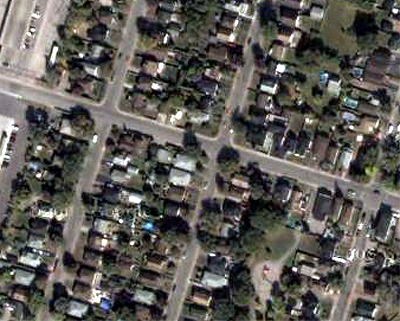
Glow Avenue (east-west) is wide, straight, and unimpeded (Photo Credit: Google Maps)
Our streets are already engineered. Traffic lights, turn lanes, one way streets, and so on, are all engineering attempts to maximize the flow of automotive traffic. Today, some consideration is given to non-vehicle safety, but it usually comes at the expense of freedom of movement, by restricting the times and places that pedestrians can move around so they don't get in the way of motor vehicles.
This is based on the false premise that streets exist mainly for automobiles, a premise that kills far too many pedestrians and cyclists each year. It's time we start engineering safety and mobility for all modes of traffic.
By Michelle (registered) | Posted September 01, 2006 at 10:50:57
Helmets can and do save lifes. wearahelmet.org
I am so sad for this family.
By helmethead (anonymous) | Posted September 01, 2006 at 14:37:06
Statistically, helmets save lives, so if everyone wears a helmet, less people overall will die in bike accidents. But you're not always able to say a helmet would have saved someones life in a particular case.
By mr.nice (anonymous) | Posted September 19, 2006 at 10:35:14
I Feel Sorry for stephan! I only met him once and i didnt talk to him then cuz we didnt no eachother! I hope stephans mother father and his little brother will be ok. R.I.P Stephan Clark,,, These ppl will never forget you...Raymond,Willie,Baron,Brittany,Jennifer,
Jessica,Adam,Brandon,Milena,Niko,Zoran! Always Remember You!!
By kennisha i love you stephan (anonymous) | Posted June 26, 2007 at 03:48:05
i love stephan ive known stephan since i was 2 he was ment to be with god im sad he left and i hate my self for the last words i said to him and i wanted him to no that and when i went to his viewing befor i steped in i started to laught like he was telling me its ok youll get through this and when i steped in i started to cry i miss him truly and i love him so much i want him to no and im glad we also got to go out we thought it would reck a wonderfull friend ship but i brought us closer i love him this summer ig going to be hard and when i turned 13 i started to crie we made a packed we would be there on each others birthdays and he wasent i broke down and i cry ever night I LOVE YOU STEPHAN(L)
By anniec (anonymous) | Posted July 22, 2007 at 15:23:34
Rest in sweet peaace
i wass in the same class with him & was there a few minutes after the accidennt
even if he was wearing a helmet he would of died cuhhz his jaw got twisted
By brandy johnson (anonymous) | Posted September 18, 2007 at 22:00:32
r.i.p stephan clarke i miss u so much like you dont even no i cry every night thinkin of you. you were a good friend everyone liked you. you were never mean to some one i dont no why this would happen too u i miss you so much. i see your mom and step dad and lil brother all the time and i always start to cry.everyone misses you so much and i even people that dont even no you still cry because they dont no how someone so specil like you can no longer not be there you were so nice and kind to every one i dont think theres one person out there that says differnt you were the nicest person i ever mete r.i.p stephan clarke one day i will see you again xoxo
By jessica t (anonymous) | Posted October 07, 2007 at 13:43:17
I was Stephan Friend and girlfriend in gr.1 and 2. The list thing we said befor I moved was that we well grt marred but I just not
I loved he alot and so did my sis
By bubblez (anonymous) | Posted January 17, 2008 at 13:37:22
rip bud we all miss you chassis wont stop crying everytime we start talking bout you AND some one stole ure hat that freaken rude i cant belive that some one would do that to you ne way im at school so i have to go luvv yaa
kayla
By liven life! (anonymous) | Posted September 11, 2009 at 11:43:21
I wish i didn't happin. But so long a go it happiend. I wish it never did i barely new you. but i knew enough to say u were a good person the night be for u passed i had a dream. That u got hit by a car and suvried but in reality u didn't but the next day. it happiened so quick and so fast. (3 years's later) i was walking down the street one day and i saw a kid walking by he looked like a spitting image of you. i stoped and cried i only knew you for a year but i was glad u were in my class i rember u always talked to everyone and at lunch u always had air heads i can never forget you and i never will ! . R.I.P buddy !!
You must be logged in to comment.
There are no upcoming events right now.
Why not post one?