Raise the Hammer

If Hamilton is going to get light rail, citizens need to take the lead in advocating for it.
By Ryan McGreal
Published September 09, 2007
I was excited to see a report on rapid transit in FredConnect [PDF], Mayor Fred Eisenberger, newsletter, but disappointed not to see the words "light rail" anywhere.
With a new Rapid Transit Office in place, Hamilton is now positioned to access transit dollars from the federal and provincial governments. Since 2005, neighbouring communities have received millions from upper level governments to develop rapid transit - now it's our turn.
In June, the provincial government proposed a new $17.5 billion provincial transit plan. Under this plan, Hamilton's transit system would receive funding for two rapid transit lines across the City. As part of the Council approved transportation plan these rapid transit corridors would include one from McMaster University to Eastgate Square and another from the downtown core to Upper James and Rymal Road.
My understanding from the Mayor's office is that Eisenberger likes light rail but wants the city to conduct the appropriate studies before making any public declarations.
If light rail was a controversial proposal, I could understand this desire on the Mayor's part to get all his ducks in a row. However, as Raise the Hammer has argued, light rail is a no brainer for these rapid transit systems.
It's cheaper to operate, faster, carries more people, attracts more new riders, and generates billions of dollars in new private investment (which completely supports the city's "nodes and corridors" GRIDS planning framework). Best of all, the province is willing to pay for its construction.
In the meantime, all city planners can talk about is bus rapid transit or BRT, which is mostly a fancy name for "buses", albeit with priority at intersections and dedicated stations.
The Transportation Master Plan's Higher Order Transit Strategy reviews the history of rapid transit in Hamilton and surveys the factors impacting transit service. Then, in a jarring non-sequitur, it hastily concludes: "it is clear that there is a strong case for the implementation of Bus Rapid Transit in Hamilton."
The strategy doesn't even consider a case for light rail, despite the fact that it is better meeting the city's goals, including a 20 percent reduction in automobile trips and 40 percent intensification targeted along identified transport corridors.
Instead, the report dismisses light rail as something to investigate as a possible upgrade from BRT in the longer term.
I lamented back in June that light rail needs a champion in the city: someone to shake up the complacency in the transit bureaucracy and enlighten council on a set of tangible benefits that even obstructionist suburban councillors can get behind.
This is the flipside of that argument: light rail needs a broad-based movement that will advocate strongly for city councillors and staff alike to move out of their transit-as-social-service comfort zone and take advantage of an historic opportunity.Unlike many contentious issues, light rail is an idea around which everyone can rally. It improves air quality and reduces greenhouse gas emisions, benefits transit users, benefits business, reduces traffic congestion (since it takes up less space than the automobiles that would otherwise have to carry its passengers), and appeals very strongly to investors and developers.
Light rail is finding support in some nominally unlikely places.
The Hamilton Spectator's editorial board formally endorsed light rail in a June 16, 2007 editorial. Forum editor Robert Howard wrote:
There are few things that can literally transform a city. Hamilton's share of the $17.5-billion transit plan announced yesterday by the province has the potential - particularly with a push for an "upgrade" - to do that. ...
[W]hat Hamilton really needs is the next step up - the 21st century solution. The proposed rapid-transit lines for Hamilton would essentially be dedicated routes for better or larger buses. This is the time for Hamilton to push the province, and the Greater Toronto Transportation Authority charged with implementing the plan, to consider light rail transit (LRT) lines for Hamilton that would replace some buses with quiet, environmentally friendly electric trains.
I asked John Dolbec, the CEO of the Hamilton Chamber of Commerce, whether the Chamber has considered light rail. He replied that the Chamber is discussing it, but pointed out that:
an effectively functioning and efficient public transit system, including possibly a solid LRT option, is a primary economic development tool, if not pre-requisite to retaining and attracting quality employers. [emphasis added]
He added that he "could not imagine anything more effectively "Triple Bottom Line" than sustainable Public Transit infrastructure enhancements, and we have always believed in 'TBL' principles - LRT smells like a real winner to me."
The next step is for these various groups to get together and cooperate on a campaign to lead council and city staff on choosing light rail.
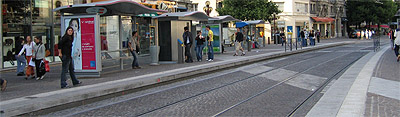
A streetcar station in downtown Grenoble.
As Nicholas Kevlahan documented in a case study of Grenoble's excellent transportation system, the government will never take this kind of initiative by itself.
It turns out that the change [in Grenoble's transportation program] began over 30 years ago, in 1974, when Jean Sivardière helped found the Association pour le Développement des Transports en Commun (ADTC, association for the development of public transport). ...
He realized that it wasn't enough for individuals to write letters to the newspaper, or to try to lobby the mayor and city officials. In order to be taken seriously Sivardière needed numbers: he needed to form a sort of municipal NGO.
They challenged the myths about transit, overcame a political culture that was wedded to highways and lane capacity, and convinced business owners that light rail would actually benefit them. They finally forced the mayor to hold a referendum on building a streetcar network, and the "Oui" side won.
If we want to take our transit system to "the next step up - the 21st century solution", we need to build a coalition like the one that established light rail in Grenoble and pressure the city into doing the right thing.
By peter (anonymous) | Posted September 10, 2007 at 17:25:46
talk about a no brainer!! unfortunately, this is why it won't happen. we have a long history of making the wrong decision when the right one is staring us in the face. i'm comforted by the fact that eisenberger understands the importance of building an lrt system but it's going to take more than that. brt would have been great...20-25 years ago! we're a city that lives eternally in the past, man.
By seancb (registered) - website | Posted September 11, 2007 at 14:04:57
"If we want to take our transit system to "the next step up - the 21st century solution", we need to build a coalition like the one that established light rail in Grenoble and pressure the city into doing the right thing."
So lets do it! Where do we start?
By Jon Dalton (anonymous) | Posted September 12, 2007 at 13:02:33
I'm there on Sept. 24. Heck even Detroit has a rail line now, granted theirs is a joke.
By Frank (registered) | Posted September 13, 2007 at 12:45:58
LRT is definitely the way to go... Add more buses and get more "bumps" in front of bus stops because our pavement structure sucks...
By unno_2002@yahoo.com (anonymous) | Posted September 19, 2007 at 14:25:55
Cars, buses, light rail, whatever you pick, remember you must be able to operate it without fossil fuels...
If the system is not operational on a long-term sustainable fuel basis, then don't bother with it. Eventually, all those dependent on burning fuel (car, bus, train, etc) to reach employment, school, shopping, etc., will be forced to stop...
Some people are have already made the transformation... Why then would those feel an obligation to pay for government provided transport for those who have failed or refused to take responsibility for their own lives?
By Frank (registered) | Posted September 26, 2007 at 11:06:36
Unno, once the infrastructure is built any vehicle using the same configuration can be placed on the tracks...whether it's running on electricity or hydrogen or hot air. Notably, as the province moves into using more electricity generated by nuclear plants, electrical power becomes more viable...provided the distribution network is maintained properly.
I'm not sure I understand your comment regarding those who failed or refused to take responsibility for their own lives? Perhaps they have and simply chose differently than you based on their circumstances.
Also, building something like an LRT system completely without the use of fossil fuels is not financially responsible especially since fossil fuels will be available for a looong time. Granted, supply/demand will most likely force the price up and make alternative energy more feasible however currently this isn't the case.
As with all projects, an LRT system should be built with future prospects in mind for the duration of the life of the system (most likely 70 years if it's concrete) however building them to run using future possibilities at inception is poor plannng. It should be built to accomodate them in the future, not use them immediately.
You must be logged in to comment.
There are no upcoming events right now.
Why not post one?