Raise the Hammer

After a busy summer, light rail is getting closer to reality for Hamilton.
By Ryan McGreal
Published September 11, 2008
With little fanfare, the city has quietly moved forward this summer on its rapid transit initiative and is poised for inclusion in the first five year rolling provincial budget for rapid transit construction.
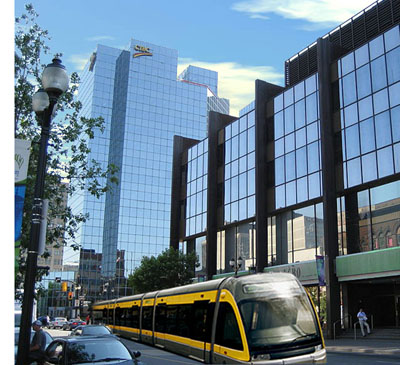
Rendering of a possible light rail line in Hamilton (Image Credit: Trey Shaughnessy)
Earlier this summer, Council authorized staff to prepare phase two of the city's rapid transit feasibility study with a focus on light rail transit (LRT).
Around 150 people had attended the city's two public information centres (in addition to the 120 who attended the Hamilton Light Rail public lecture and panel discussion).
The city received 116 written responses to their request for public input, of which the overwhelming majority supported LRT (71 percent) or rapid transit in general (91 percent) with only 4 percent preferring Bus Rapid Transit (BRT) and 9 percent opposing rapid transit.
Some councillors expressed concern that this feedback, while extraordinary for a positive initiative, may not be representative of the majority opinion. In response, staff disseminated a survey through a variety of media to try and get a larger sample of public opinions.
The phase two report is still in development, but Lisa Zinkewich from the public works department reported that the city received an unprecedented 1,300+ responses.
In a report published today, staff note that the total to date is actually over 1,600 responses!
The results are consistent with the comments from the earlier public input: 66 percent supported LRT, 8 percent supported BRT, 20 percent supported either BRT or LRT, and only 6 percent supported neither.
The phase two report will include this feedback, plus more detailed studies into economic development, the possibility of using the Claremont Access rather than James Mountain Rd., traffic impacts of lane reductions, and options for building the rapid transit system in stages.
Staff and some members of council also traveled to Calgary, Portland OR and Charlotte NC to meet with their transit officials and experience their LRT systems firsthand.
Mayor Fred Eisenberger said of the trip, "Light Rail is transformational - it's about rejuvenating a city, promoting growth and intensification."
He added:
Four- and five-story condo buildings were being constructed all along the LRT lines and office uptake in the core was substantial.
One thing that stood our is how proud each of these cities were: of their LRT systems, but also of their communities in general. There was a real sense of optimism, ownership, and pride in the systems they had built.
The rapid transit team will not present the completed phase two report to the public works committee until after Metrolinx publishes its Regional Transportation Plan, expected at the end of September.
Staff have been in regular contact with Metrolinx through the summer, so they have a general idea of what to expect in the Plan.
An early draft was recently leaked to the news media. While most of the coverage concerned its total cost of $55 billion and the conflict between Metrolinx and the Toronto Transit Commission over a proposed subway-like RT on Eglinton, it does include the rapid transit lines in Hamilton.
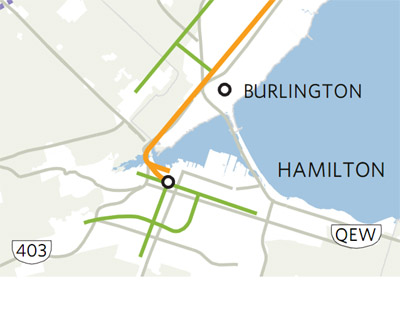
Transit Map from the leaked RTP draft shows three rapid transit lines in Hamilton (Image Credit: Toronto Star)
While Metrolinx officials caution that the plan is still in development and the leaked version is still evolving, the following seems clear:
That means Hamilton city council needs to move quickly on approving its proposal for LRT in Hamilton so this project can move closer to the top of the heap.
Another major issue is the upcoming federal election. The Regional Transportation Plan cannot go ahead without matching capital funds from the federal government, and that can't happen until after the election.
One positive outcome of this timing is that the federal candidates will be under some pressure to express support for, and commitment to, the transportation plan.
So far, all three major parties - the Conservatives, the Liberals and the NDP - have expressed support for improving transit. Earlier this year, Conservative MP David Sweet was very supportive of light rail in Hamilton.
Here's one potential timeline to completion of a light rail system, assuming all goes well. Note: this is purely speculative, hopeful thinking on my part.
Late September, 2008 - Metrolinx presents the Regional Transportation Plan, which includes two light rail lines in Hamilton.
Early October, 2008 - City staff present phase two of the rapid transit feasibility study to the public works committee. The committee approves it and refers it to Council.
Late October, 2008 - Council receives the study and votes to pursue light rail.
December, 2008 - Metrolinx releases its first rolling five-year budget, which includes provincial capital money for Hamilton's light rail plans.
March, 2009 - Hamilton starts a class environmental assessment (EA) on its two light rail lines.
June, 2009 - the federal government agrees to increase the gas tax transfer earmarked for transit operating costs. The province announces matching operating funds as well.
September 2009 - the EA is completed with a staged construction plan.
December 2009 - the federal government commits to matching capital funds with the province for building Hamilton's light rail system.
April 2010 - Hamilton starts construction of the first phase of its light rail system.
July 2012 - The mayor of Hamilton and director of Metrolinx cut the ribbon on Hamilton's new light rail line!
Within the first few months, even the doubters start to come around, as ridership exceeds projections and new investments start to flow into the transit corridor.
The line becomes a spur for new development, urban revitalization and economic recovery. Hamiltonians feel swelling pride and optimism at having mustered the political will to see such an important, ambitious project through to completion.
By excited (anonymous) | Posted September 12, 2008 at 08:53:53
Thanks for the update Ryan! It's great to have a such a concise and informative overview of the current happenings concerning Hamilton's transit initiatives. Let's hope there is strong political will and public support for launching LRT in Hamilton and it's connection to a broader public transportation corridor to the GTA. I really think Hamilton's prosperity and revitalization is tightly tied to the successful rollout of the transit plans outlined in your article.
affecting I am very excited about t
By excited (anonymous) | Posted September 12, 2008 at 09:12:30
Thanks for the update Ryan! It's great to have a such a concise and informative overview of the current happenings concerning Hamilton's transit initiatives. Let's hope there is strong political will and public support for launching LRT in Hamilton and it's connection to a broader public transportation corridor to the GTA. I really think Hamilton's prosperity and revitalization is tightly tied to the successful rollout of the transit plans outlined in your article.
affecting I am very excited about t
By k $ (anonymous) | Posted September 13, 2008 at 10:06:24
Keep pushing, Ryan. Light rail in Hamilton will be AWESOME!
By Undustrial (registered) - website | Posted September 23, 2008 at 11:04:47
I bet more people would comment if they were upset. Sure there's some issues surrounding rapid transit which still have to be resolved (are we running it out to new housing developments on Rymal, or down Barton, one of the busiest bus routes in town?), but I have confidence that it'll be hard to make worse use of this cash than if it were used to build new roads.
Bravo.
By Chris (registered) | Posted September 25, 2008 at 14:31:42
I think Fred needs to start some sort of advertising campaign for LRT. I mean...the only people that are aware of this proposal so far are the ones that are hardcore about Hamilton. Most people haven't even heard about it.
Why not spend a bit of money and put up some advertising around the city? Have a representative go to the Mohawk campuses and McMaster and spread the word, get people interested and informed.
The more people that know about it and are informed, the better its going to be for all of us and hopefully the more likely we see LRT in the future.
-Chris
By A Smith (anonymous) | Posted September 27, 2008 at 18:46:49
If LRT is such a great investment, then why aren't private firms building it in response to consumer demand?
Oh that's right, there is no consumer demand for LRT, only demand from those who like using other people's tax dollars to build their pet projects.
Why not look use history as a guide, whereby you would learn that the private sector was quite successful in building the HSR and the same could be true today if the government would get out of the way.
By reuben (registered) - website | Posted September 28, 2008 at 12:43:02
A Smith, did you just say that there is no demand for LRT and then in the next breath say you believe it would form on its own in a free market?
if the same product would result from either system, why not just sit back and let it run its course instead of complaining about government interaction only to hope for the same result from a free market?
By highwater (registered) | Posted September 28, 2008 at 15:28:10
Reuben, Reuben, Reuben. Complaining about government interaction is what A Smith does. Results matter not in his Randian dystopia. If there has been so much as a whiff of government oversight, let alone involvement, it is ipso facto a BAD THING.
Don't let him suck you down the rabbit hole. Get out of this argument while you still can.
By reuben (registered) - website | Posted September 28, 2008 at 16:09:06
oh, dont worry, im not about to get into a debate. i just thought this comment was particularly contradictory.
By A Smith (anonymous) | Posted September 28, 2008 at 17:10:14
Reuben, what I said was that the private sector has a history of building mass transit, as was the case with the HSR.
Therefore, the argument that government needs to invest in LRT is without merit. If a service such as LRT is being demanded by the consumer, the market will build it.
What I suggest is abolishing the city owned HSR and allowing the consumer to decide what transit services they will support. I don't know what these will be, but like all things offered in the free market, it will be decided by supply and demand, not politicians.
Any argument against allowing the free market to decide what gets built, is based on the idea that politicians know more about consumers preferences that they themselves do. Ridiculous.
By monorail Monorail MONORAIL! (anonymous) | Posted September 28, 2008 at 21:46:51
A billion dollars to build a rail line across the city to replace what the Bee Line is already doing... Will it cross town any faster? Not likely if it is at street level and has to contend with the same cross traffic as the buses do now... What is the point exactly???
This Metrolinx money doesn't just fall from the sky like they pretend. No, it is coming out of all of our pockets through our taxes at some level... What percentage of the population will ever use the system or a regular basis? <10%? Is it really fair to expect some many to pay so much for so few? This is wasteful largess at its most extreme. They framed the study as if there was all this free money coming in so would you rather get a gold plated monorail or another rusty old bus? Where was the connection stated that the preferred rail option would cost like 5x as much money? Do you think people would really pick the grossly expensive option if they were told they'd be picking up the tab? Instead they say the funding comes from some futuristic new group called Metrolink that no one's ever heard of like pennies from heaven. Why not say, "Would you like us to rake in an extra one billion dollars from your taxes so that we can (give it to Metrolinx) build a train line through the middle of town where the buses are already getting the job done?" Then watch the survey results change. We're all getting snowed here as a minority of people who need subsidized transit to get around overwhelming support a plan to fleece everyone else while the media plays along with the free money story so the masses don't catch on... The apathy is revolting.
By A Smith (anonymous) | Posted September 28, 2008 at 22:59:55
Monorail, the people that support this idea don't care about who pays for it, as long as it gets built.
They live in a world where democracy equals morality and where the government's job is to force successful people to handover the fruits of their labour.
That is also why they hate when I talk about the free market, because it means they would actually have to work for everything they receive.
Life is so much sweeter when someone else can pay the bills.
Unfortunately, karma has a way of getting back at those that resort to force in order to get what they don't deserve and Hamilton is a great example of this.
By Civic Values (anonymous) | Posted September 29, 2008 at 07:22:23
Where were you guys when the Red Hill Extortionway was being debated? Why aren't you spending time blogging against the $700b bailout of the Wall Street scammers? Oh that's right, laissez-faire economics and individualism are only invoked when the subsidies are going to those who need them for daily survival. Soc'lism (spam filter) for the rich, capitalism for the poor.
By A Smith (anonymous) | Posted September 29, 2008 at 17:43:51
Civic Values, I agree with you 100%. When oil was rising and the US dollar was falling (for a few years) nobody thought anything was wrong with the US economy.
Now that the dollar has strengthened and oil is on the retreat, the experts are crying for a bailout, lest the US economy fall into a depression.
This is nothing more than a former banker helping out the industry that made him rich.
By a pheasant in every pot (anonymous) | Posted September 29, 2008 at 22:53:09
"laissez-faire economics and individualism are only invoked when the subsidies are going to those who need them for daily survival." - A billion dollar train is not needed for daily survival.
"The money comes from the province (and some will likely come from the federal government). " - And all of this come out of the pockets of taxpayers. It doesn't matter what agency doles it out, they're taking it out of our pockets first.
"One major benefit of LRT is that it attracts many more new riders" - From Road to Hell is Paved with Public Transit, Neil Reynolds, Globe and Mail, May 21, 2008: "Since 1992, American cities have invested $100-billion in urban rail transit," Mr. O'Toole says. "Yet no city in the country has managed to increase [public] transit's share of commuters by more than 1 per cent. No city has managed to reduce driving by even 1 per cent." Go ahead and blow off this article as right wing propaganda from the oh so far to the right Globe and Mail... The right isn't entitled to have a differing opinion anyway.
Who is even asking for rail service to the airport anyway? By the time this thing is done, air travel is going to be hugely expensive. IF passenger service isn't just consolidated in Toronto anyway, the only people who will be able to afford to fly certainly won't be lugging their suitcases onto public transit to get to the airport!
I'm struggling to get by and support a family on a small salary. My neighborhood is not serviced by transit. I resent that taxes will have to skyrocket on all levels to pay for this. What about paying for real priorities that impact on public health like crumbling sewers and water mains or closure of emergency medical facilities? No, lets order up a billion dollars worth of trains when the bus is already doing the job. The city infrastructure is falling apart with no money to fix it but we've got money for this???
By Civic Values (anonymous) | Posted September 30, 2008 at 17:09:02
>A billion dollar train is not needed for daily survival.
Public transit is needed for daily survival - more than 10% of our city already uses the HSR. I was contrasting public investment into auto infrastructure, which benefits some citizens exclusively, with public investment in transit, which is inclusive (poor, disabled, young, elderly).
>Who is even asking for rail service to the airport anyway?
Not me. I'm an opponent of aerotropolis. On my response to the rapid transit public consultation, I argued that the a-line go as far as Mohawk, and that other lines should be constructed along Mohawk, and along Barton.
>I'm struggling to get by and support a family on a small salary. My neighborhood is not serviced by transit. I resent that taxes will have to skyrocket on all levels to pay for this.
Understood. But understand this: your low density mode of existence(suburban? rural?) claims a larger proportion of public money for water, sewer, ambulance, fire, etc. Because you drive long distances every day, you consume a much greater amount of the public roadway, and generate a much greater need for road maintenance. So "we" subsidize you, perhaps to a greater extent. (Remember: a lot of taxpaying white collar workers live downtown.) And the subsidies that you consume are ecologically unsustainable. As a municipality, we can work through these differences democratically. But not with the crass attitude that you display.
By Civic Values (anonymous) | Posted September 30, 2008 at 18:04:07
A Smith:
I know you agree with me that the proposed (failed?) bailout of Wall Street. What I'm suggesting is that your emphasis is skewed. Have you even read The Wealth of Nations by Adam Smith? It's a polemic against mercantalism, not soc'lism (spam filter). Soc'lism didn't exist yet.
Did you know Smith was against corporations? Huge, centralized, bureaucratic institutions with the rights of individuals? Come on! People who are in favour of untramelled corporate power have no right to call themselves "libertarians" (a term which originated as a synonym for social anarchism until Ayn Rand et. al hijacked it.)
What do you think Smith would think of our Chamber of Commerce, which is organized collectively and politically to lobby for the interests of the "business community"?
Most of the content of this website revolves around the very real problem of sprawl and mass motoring, which are already highly subsidized. In the 50's this living arrangement was planned, top down, federally - from the huge mortgage subsidies doled out by the Canadian Mortgage and Housing Corporation to the monumental taxation that underwrit the development of the freeway system.
The developers who run this town (and by extesion, the tycoons who run the world) don't believe in laissez faire. They believe in big government megaprojects that benefit them. It's the same behaviour that Smith was arguing against when the British Navy was sailing around the earth, using state violence to reorient the world's labour markets in the interests of merchants.
I ask you: where would the "free choices" of suburbanites be without the persistent, violent presence of the U.S. military-industrial complex (with its multi-trillion dollar debt) in the Persian Gulf?
Most people who use this site believe that some form of social planning is needed to solve the problem of sprawl. Your 19th-century liberal viewpoint is a welcome contribution to the topic. All I'm suggesting is that you fashion your polemic consistently. In the authentic tradition of Adam Smith, you should be railing against the manipulations of the Chamber of Commerce and the developers, who have used City Hall and other public institutions for their own private gain.
By Civic (anonymous) | Posted September 30, 2008 at 19:02:10
Back to the topic at hand:
These economic debates are moot; they only serve to distract. Transportation infrastructure is going to be essentially public regardless of the form it takes. Mass motoring and sprawl are subsidized, top-down, and planned. By the same token, transit-oriented development and new urbanism, on their own, are not going to fundamentally alter the power relations of our society.
The debate over light rail needs to be recognized for what it is: a TECHNOLOGICAL debate.
Whether fully public, or funded through a public-private partnership, light rail is a better technology than roadways clogged with single-occupant cars. The former consumes less space, less energy, and integrates better with other human activities, including commerce (though the more human scale might favour independent merchants over corporations). Overall, the expenditure needed to service a city with more compact, efficient land use will certainly be smaller.
That's why influential Hamiltonians of all classes and political stripes are starting to agree on it.
By Civic (anonymous) | Posted September 30, 2008 at 19:14:29
Back to the topic at hand:
These economic debates are moot; they only serve to distract. Transportation infrastructure is going to be essentially public regardless of the form it takes. Mass motoring and sprawl are subsidized, top-down, and planned. By the same token, transit-oriented development and new urbanism, on their own, are not going to fundamentally alter the power relations of our society.
The debate over light rail needs to be recognized for what it is: a TECHNOLOGICAL debate.
Whether fully public, or funded through a public-private partnership, light rail is a better technology than roadways clogged with single-occupant cars. The former consumes less space, less energy, and integrates better with other human activities, including commerce (though the more human scale might favour independent merchants over corporations). Overall, the expenditure needed to service a city with more compact, efficient land use will certainly be smaller.
That's why influential Hamiltonians of all classes and political stripes are starting to agree on it.
By Undustrial (registered) - website | Posted September 30, 2008 at 22:12:05
Running the A-line to the airport is pointless. It's been proved multiple times that the airport can't even support a simple bus route. Add that to the fact that Upper James houses the bus depot, making it's southern end the easiest part of Hamilton to service with buses.
Build the east-west and transfer the BRT capacity there to the next proposed LRT route, in this case, James. If they're all running empty after Rymal, then why should we spend tens of millions a km to send it farther? Building LRT to support devlopment lands (the Rymal route and southern part of A-line) on lands that barely support bus service is insane with the kind of demand which is already overwhelming buses in the lower city. Then again, I suppose it's just as silly as building highways out there while downtown's roads rot.
undustrialism.blogspot.com
By A Smith (anonymous) | Posted September 30, 2008 at 23:30:47
Civic Values, I don't disagree with most of what you say, except perhaps taking my screen name to literally, perhaps my own fault.
I agree that corporations use government for their own ends, but that is only because government has been given to large a role in our lives.
The old saying "be careful what you wish for" applies perfectly here, since corporations are simply accessing the same tax dollars that support the welfare state. Get rid of the welfare state and you get rid of corporate welfare as well.
Allow each person to keep the bulk of his/her earnings and individuals will decide what is more important, private transit, or private roads.
Either way, the decisions will be left up to the consumer. In this way, each of us will get to vote how to spend our dollars, rather than letting the majority do it for us.
We all get what we work for and no one can claim that we're getting screwed over. Real simple and clear.
By K Lagerfeld (anonymous) | Posted October 01, 2008 at 00:42:27
"I agree that corporations use government for their own ends, but that is only because government has been given to large a role in our lives."
You're delusional A Smith. Corporations don't want free markets. They know free markets wouldn't last five minutes. Corporations WANT government to do what they want, they'd go on wanting that even if Joe Citizen didn't want government in his life. Taking PEOPLE out of government just leaves it wide open for big business to take over completely, I can't for the life of me figure out how you don't see this.
By vfjr (anonymous) | Posted October 01, 2008 at 13:15:46
I like the photoshop picture at the top... wouldn't it be great if they turned the old Bank space there above the street into a train station? How sexy wopuld that be! LOL!
By vfjr (anonymous) | Posted October 01, 2008 at 13:18:18
I like the photoshop picture at the top... wouldn't it be great if they turned the old Bank space there above the street into a train station? How sexy wopuld that be! LOL!
By Civic (anonymous) | Posted October 01, 2008 at 17:02:33
Private roads!?! That's why no one takes you lot seriously, including yourselves. If the corporate elite don't want consistent laissez faire, and the working classes don't want it, then who's going to fight a revolution to install it? Let me guess: the masses of disgruntled economics students. "You have nothing to lose but your calculators."
Oh yes. And the famous "vote with your dollars". Unfortunately, I hear this a lot from environmentalists. There is some good in ethical consumption. However, not everyone has the same amount of dollars; therefore not everyone has the same amount of votes. Eliminating the collective, political dimension of these issues is ultimately regressive and disempowering.
How do you think market competition would work on a rail line anyway?
The sad thing is that there are problems with the Metrolinx program. It is top-down, centralized, and bureaucratic. But this will certainly get lost among economistic arguments about taxes and subsidies, which really miss the point entirely.
By A Smith (anonymous) | Posted October 01, 2008 at 18:06:14
Civic, what is so unique about roads that disqualify them from being offered by the private sector?
A lot of people already choose to take advantage of the 407, so why not allow the market to build even more roads for their customers?
If the government got out of the road building business, private firms would simply fill the void, assuming there was strong customer demand.
This scenario would also allow mass transit the opportunity to compete on a fair playing field with our current "driving culture".
By pricing roads at their true cost, I think many people would find it cheaper to live in denser communities. For those who don't like the idea of urban sprawl, this should be music to your ears.
By Dr Downtown (anonymous) | Posted October 01, 2008 at 20:32:59
"Civic, what is so unique about roads that disqualify them from being offered by the private sector?"
Mind if I interject? The same unique thing that's why you don't have five different hydroelectric lines running down the street. It's a natural monopoly and competition would not improve its efficiency but would make it less efficient through duplication..
"A lot of people already choose to take advantage of the 407"
The 407 wasn't provided by the private sector. It was built by the government (oooh!) and sold to a company to manage it. There's no reason the government couldn't have kept the highway themselves and collected the tolls.
By the way I'm all for tolls because they send important price signals, but they don't need to be privately owned to do that--as the 407 ironically demonstrates.
"By pricing roads at their true cost, I think many people would find it cheaper to live in denser communities."
I agree with you here but see absolutely no benefit to letting private companies run roads that the government can't also accomplish. In fact the easiest way to price roads is to simply raise the tax on gasoline, something private firms couldn't do (unless you decided the government should licence the right to tax - oops, I shouldn't give you any ideas).
By A Smith (anonymous) | Posted October 01, 2008 at 23:26:31
Dr Downtown, the reason why there are not five electric lines running down the street is because government forbids it.
It's government that gives local power distributors the monopoly you speak of, therefore until you remove these artificial restrictions, you can't say that there wouldn't be five lines on the street.
With regards to private roads, profits would motivate road owners to maintain and operate them in the most efficient manner for paying drivers. If they did not, the area the road services would fall out of favour and the road owners would lose well paying customers.
You mention that the 407 was built by the government, so what. Are you saying that the expertise it takes to build a road is beyond the scope of the free market? Hardly.
You also mention that you are in favour of tolls, but don't see why the toll roads couldn't be owned by the government. I would say it's the same reason why governments shouldn't operate grocery stores, car dealerships, electronics stores, etc. Government bureaucrats do not operate by the profit motive and therefore don't feel the need to satisfy their customer.
Moreover, since government has the ability to cover losses with tax revenues, they can afford to run the toll road less efficiently than private operators.
For a private toll operator, there is every incentive to provide more and better service, while also using less capital to do so. This frees up the nations capital to be invested in other businesses.
As to your point about gas taxes being able to substitute for tolls, what about people who consume gas for non road driving uses. Farmers, boaters, lawn maintenance firms, etc, would end up paying for roads they're not using.
Tolls only target actual drivers and as such are the most precise way of pricing road use.
You must be logged in to comment.
There are no upcoming events right now.
Why not post one?