Raise the Hammer

So the future didn't happen. Does this mean we destroy all the Brutalism style buildings, much the same as we tore down all our Victorian and Georgian streetwalls?
By Trey Shaughnessy
Published May 31, 2005
The Brutalism style of architecture is a sub-style of the Modernist period (post-war to 1975). It was largely built during the 1960s and '70s. Brutalist buildings are defined by their exposed, bunker-like, bare concrete walls, and usually have main entrances not oriented to the street - a major criticism of the old Art Gallery of Hamilton building.
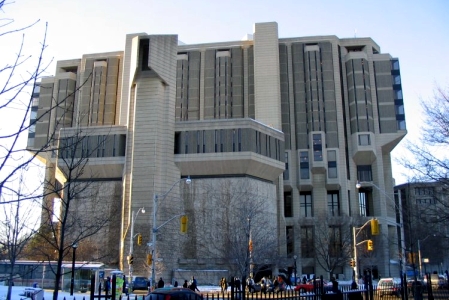
Robarts Library, University of Toronto (built 1973)
Swiss architect Le Corbusier can be blamed for the name, taken from the French words for "rough concrete" (beton brut), which doesn't translate very well into English. To some degree it is an appropriate term to describe some Brutalist buildings, which often feature windowless blank walls.
Hamilton has its share of Brutalism. In fact, you can tell when a city went through a prosperous time by the clusters of building styles built during a period. In Hamilton, we can see many fine buildings built in the style of, Georgian, Edwardian, Art Deco, Art Moderne, International, Modern, and Brutalist.
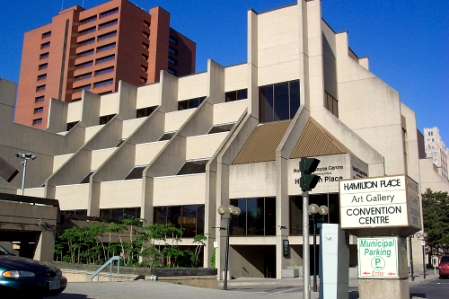
Hamilton Place (built 1972); Trevor Garwood-Jones, architect
In contrast, Hamilton has very few Post-Modern buildings. This suggests Hamilton was prosperous in the late 19th century, early 20th century, pre-war, and post-war and throughout the 1960s and '70s, but not much happened during the '80s and '90s.
Studying architecture can be very similar to studying Art History. By studying a style that dominated a certain period of history, we can learn what was important in a society, how technology impacted life, and what was feared, or revered during a period of time. From this, historians extrapolate a snapshot of social values, which are largely shaped by economics, religion, and politics.
With a global economy that has managed to homogenize everything from architectural, fashion and graphic design, historians in the future will have a difficult task in determining what was happening in Shanghai or Toronto, simply because the same buildings are built, the same clothes are worn, the same music is listened to, and the same movies are seen.
Brutalism was one of the last architectural styles that pre-dated globalism. It was a time when society thought the future of science-fiction novelists was upon us. Le Corbusier and the new modernist movement sought to eradicate the past, and its irrelevant urban lifestyle. The streets would become highways moving mass numbers of automobiles, the street-life would be moved indoors or elevated above the street.
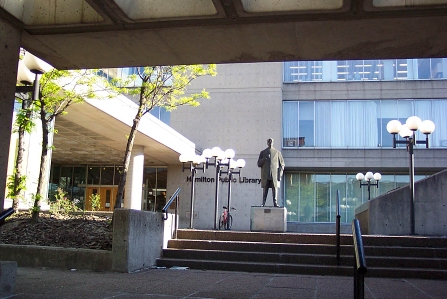
Hamilton Central Library has an obscured main entrance
Our lifestyle would be filled with modern inventions, and a totally new evolved society would require a re-fabricated neo-urban environment. York Boulevard, for example, paved over a Victorian streetwall to make room for Modern skyscrapers that didn't happen. Hamilton, like and other Canadian and U.S. cities, went on a rampage during the '60s and '70s to eradicate Victorian architecture. Victorian buildings were regarded as dirty, old, and of little use in a society that would be jet-packing around by the 21st century.
So the future didn't happen - at least not how it was envisioned. Does this mean we destroy all the Brutalism style buildings, much the same as we tore down all our Victorian and Georgian streetwalls? Bruce Kuwabara's new AGH proved they can be renovated to a more human scale. In fact, the new-new-modernists, known as New Urbanism, seek to return to a simpler, more human urban environment. New Urbanism stresses more compact neighbourhoods, calmer car traffic, public squares, public transit, less reliance on cars, local food sources, and buildings that acknowledge the street.
Brutalism demonstrated that the street is relevant. Streetlife is what makes Toronto's urban neighbourhoods so successful. "Eyes on the street" make them safer, and streetlife makes our city walkable, socialable and livable.
Brutalism buildings in Hamilton define an era in our history and for that reason they are significant. These buildings were built to last and are structurally strong. Conversely, suburban development is only built to last for one generation and for that reason is not significant.
Bruce Kuwabara's architecture firm, KPMB, has done a fantastic job of renovating an unfriendly building. I hope it is the start of renovating an unfriendly downtown.
By cc omadagain (anonymous) | Posted None at
i wonder if a similar rennovation of robarts is on the horizon? it's like working in a broken factory; nice to know you're in a part of history ... but not very comforting to know it was a part designed to make you uncomfortable;
By SENDI (anonymous) | Posted August 23, 2006 at 09:56:40
THIS IS COOL
I ANM AN ARCHITECTURE STUDENT AND IT'S GREAT TO FIND INFORMATION ON TOPICS OF INTREST ON THE NET. DO U HAVE ANY MORDERNIST BUILDINGS IN HAMILTON?
SKAJUMBA@YAHOO.COM
By newbrutalism (anonymous) | Posted August 07, 2007 at 06:58:04
let's visit new brutalism before they destroy it all
newbrutalism.awardspace.co.uk
By adam (anonymous) | Posted May 14, 2009 at 20:40:04
Brutalism is beautiful. It represents a style from its era, as much as the current fad of ground-to-roof glass and eco-friendliness. But the good thing is, is that when something gets torn down, it can always be rebuilt. Sadly, the people in Rosslyn, VA want to remove the skywalk that keeps people safely away from cars, provides direct Metro access, and a walkable, livable environment.
By Raoul D. (anonymous) | Posted May 31, 2010 at 21:08:01
Unfortunately, Brutalism as a design style had been discredited by the time Hamilton got around to employing the Architectural firm that suggested it. Our general ignorance of such trends allowed construction to go forward on what has to be the most people-unfriendly buildings ever designed. The lack of a "face" on either the Convention Center, Art Gallery or Hamilton Place, has discouraged use by the very people it needs to survive. The anti-luxury interiors extend the theme and make for a very barren and uninviting performance and gathering space. They are catastrophically ugly and cheap. Judging by the crumbling exterior, leaking roofs, windows and doorways, heaving floors from frozen plumbing and general shabbiness of the interior, your comment that they were built to last is receiving a stress test. I personally hope they fall down. Perhaps a real Theatre would arise from the rubble.
By TreyS (registered) | Posted March 03, 2012 at 20:06:31
Save Scott Park before it's too late.
By lawrence (registered) - website | Posted March 07, 2012 at 13:43:00 in reply to Comment 74975
Just spotted this article and now your comment. :) In the end of the stadium debate you know what I actually wanted to save most? Parkview. Not neccesarily the existing home of this program, but what exists in education currently.
Everything around it became to be about what it could add to keeping the Parkview program on Balsam. The stadium, working with the Cats/minor sports, the arena, the pool and what we could do as a re-use of Scott Park even before I knew what Brutalism was the other day. Ya. I didn't know. Now you have me looking around Trey.
Read the description under this video. Talks of neighbours and children coming to watch the airband shows at Scott Park. Talk about a feeling of community.
Comment edited by lawrence on 2012-03-07 13:54:36
By Fred Street (anonymous) | Posted October 15, 2012 at 14:59:04
Fitting, in light of the restoration work currently being done to Hamilton Place.
- -
Ulrich Franzen, a German-born architect whose fortresslike buildings seemed to buttress the interior landscape of New York City during the shaky 1970s, and who gave it some buoyance, too, with skywalks, died on Oct. 6 in Santa Fe, N.M. He was 91. His death was confirmed by his wife, Josephine.
Not everyone liked the skywalks, which connect buildings Mr. Franzen designed at Hunter College on Lexington Avenue. Neighbors lamented the loss of sunlight. But Mr. Franzen, a Modernist subscriber to the form-follows-function credo, considered them the functional equivalent of ivy-covered walkways for urban students. It would “become the college community’s main street,” he wrote of the skywalk plan in 1972 in the college’s student newspaper, “well above rush-hour traffic at street level.”
http://www.nytimes.com/2012/10/14/arts/design/ulrich-franzen-architect-of-new-york-buildings-dies-at-91.html?_r=0
You must be logged in to comment.
There are no upcoming events right now.
Why not post one?