Raise the Hammer

The best way to change Hamilton's image is to change Hamilton's reality. It's time to stop saying, "I love Hamilton" and start meaning it.
By Ben Bull
Published February 19, 2005
The first time I saw the smokestacks of Hamilton I knew one thing for certain: I wouldn't be going there in a hurry.
Like many people my first view was from the bridge. It was memorable, but for all the wrong reasons. I was driving to Niagara Falls with my wife and kids. It was a beautiful July day and our spirits were high.
The radio was blaring inside the mini-van and the kids were singing along to some teen pop crap. My wife was turning upside down trying to read the map and I was enjoying the view. But then we hit the Skyway, and reached the crest of the bridge.
When we saw the belching smokestacks and filthy slag heaps dead ahead, the singing stopped, and we all just stared.
I had never seen anything like it. I come from the north of England where the word 'grim' gets it's meaning, but this view of Hamilton was without doubt the most depressing I had ever seen. I thought of the enormous concrete power station chimneys along the M1 motorway in Sheffield, the menacing outline of the ICI Chemical works on the River Tees in Middlesborough, and the boarded up downtowns of Darlington and Stockdale. These were grim sights indeed. But none of them compared to the one before me right now.
As we hit the bottom the Steelworks were framed in the passenger side window. I searched for some chink of light poking through the filthy portrait to redeem the view. But there was nothing.
"How can people live there?" I wondered out loud.
"It's horrible," was all my wife could say.
I'm sure my experience is not unique. Last year the Green Berets put together a show about Hamilton's image. As part of the preparation I questioned about 20 friends and colleagues on their impressions of Hamilton. Their responses were brutally honest and, unfortunately, confirmed my suspicions about how people think we look from "the outside."
One respondent wrote:
"The first impression isn't good...all the industrial stuff along the bay...a smell in the air...dirty and cold looking...polluted...lots of smoke stacks."
When asked what thoughts Hamilton conjures up in the minds of Torontonians, the answers were similarly grave:
"Dirty, backwards."
"Hamilton is a dump...a poor cousin."
"It's hard to find anything exciting about Hamilton."
Some responses were even more depressing:
"(Hamilton is) Stinky and run down...populated by pig farmers."
And even this:
"(The image of Hamilton is)...men with mullets who don't want to work...Women with mullets who don't want to work...Welfare welfare welfare."
Of course this little survey was wholly unscientific. StatsCan would probably rate it accurate 19 times out of a 1,000,000 plus or minus 500%. But for me at least, it gave me pause for thought.
How much does our image matter? I wondered. I mean, who cares if we don't look too hot to outsiders? It's not like our prosperity is tied to this in any way - Is it?
During my research into the revitalization taking place in other cities I came upon an image survey - link here - that was carried out by my home town of Leeds, in England. It states:
Numerous cities across Europe and indeed the UK, are recognizing the benefits of city image marketing...those that have pioneered such thinking have been acutely aware for sometime of the role city image marketing plays in investment decisions that impact on the long-term regeneration of our cities.
I contacted the Leeds Development Department. Manager David Baggely sent me an e-mail outlining his thoughts on the importance of image and image marketing.
"The City Image study ... shows that we need to 'turn up the volume' if we are to realise our ambitions to raise the profile of Leeds on the European stage."
Leeds - and many other towns Raise The Hammer will be looking at over the next few issues - is certainly worth a look at when it comes to understanding what it takes to turn a town around. From a rapid decline which saw the city lose 20 percent of their manufacturing jobs from 1951 to 1972, and left the downtown in a depressing and dilapidated state similar to Hamilton's, Leeds has recently been voted Visitor City of the Year by the 2004 Good Britain Guide and Best City for Business. They have turned themselves around.
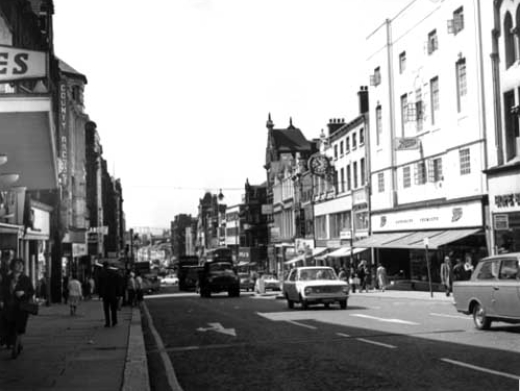
Leeds Main Street – Briggate, 1970. Leeds was a drab place to live, with no image worth marketing.
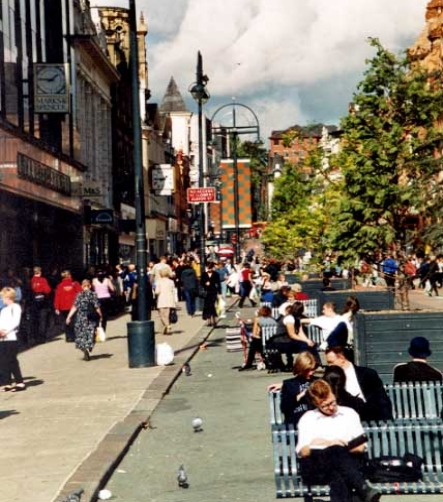
The same street today. Leeds has brought the life back into their downtown and their neighbourhoods. An image marketing campaign is underway.
It appeared to me that Leeds' efforts to market itself were a significant factor in this revitalization. But I wasn't so sure. I wondered - is it just simple marketing that makes the difference? Can we turn Hamilton around with a bit of research, a few fancy pictures and some neat slogans?
The recent failure of Reach, Dream, Rise, Shine to create any lasting momentum would suggest otherwise. And while the starry eyed "I love Hamilton" campaign may have been a useful first step in the effort to create much-needed positive energy, it hasn't exactly set the town alight.
So what have we missed? Where have we gone wrong in our efforts to promote a positive image?
I got what might be the answer to this question in some of the additional responses to my image questionnaire. In answer to the question, "How important do you think a town's image is, in attracting outside investment and tourism?"
A running theme emerged:
"In order to improve your image, you have to improve your reality."
"Image is important, but you have to make Hamilton a place people would want to live before it becomes attractive to investment and tourism."
These comments were echoed by ex-Leader of Leeds City Council George Mudie, when I spoke with him about his town's revitalization, "Politically and socially you can't ignore people in your city. This affects how your city looks, and its success."
As with many aspects of urban revitalization - nothing is simple. But the idea of improving a town's image from within certainly resonates with me. Leeds did not conduct image surveys until their revitalization was well underway. And to the best of my knowledge they do not appear to have foisted any silly little slogans on their unsuspecting citizens. Because for Leeds - and all successfully revitalized cities - their image reflects their reality.
What Leeds has created is a tangible improvement in the quality of life factors for all (well, most) residents. What they have obtained is a positive momentum, a very real excitement and a renewed sense of pride. And, maybe, what they have found is that it is this energy - this message carried all the way around the world by proud Leodians - that sells the city more than anything else.
It's easy to say 'I Love Hamilton' when you desperately need to feel better about your reality. But, as you dig deep again to pay your skyrocketing property taxes, settle down for your intolerably long commute, or struggle to have just a bit more fun in the Hammer - it's hard to mean it.
When I finally did make it into Hamilton I took the 403. What a difference a road makes. I loved Cootes, I loved the old buildings in the downtown, and I loved the down to earth feel of the place. I believe that Hamilton has a huge potential to improve its reality. I just hope we begin to understand that it is this - more than anything else - that will turn the town around.
It's time to stop saying 'I love Hamilton', and start meaning it.
By Tdottransplant (anonymous) | Posted October 22, 2008 at 11:29:43
I wholeheartedly agree with your comments. I am a recent transplant from West Toronto to Central Hamilton. I purchased my first home in Hamilton due to the overwhelming cost of real estate anywhere near Toronto. I wanted an impressive character home, the likes of which you may find in High Park or Leaside, and found such a home, complete with Walnut Trim, solid oak staircases, usable attic, and bedrooms I could swing a cat in (if I so chose). I am two blocks south of the escarpment, 4 blocks from Gage Park, and two blocks from where the decency of Hamilton's former beauty sharply ends and desperation begins. I am hoping that this new city of mine turns around. It is so depressing and I will be gritting my teeth for the entire 5 years I have obligated myself to living in this place (here's hoping I get some compensation for pain and suffering reflected in the price of my home upon selling). That is, UNLESS I see some real action by City Hall that will inject some confidence into my West-Toronto-yearning veins.
It really is too bad that such a beautiful and old city, with all it has to offer by way of architecture and close proximity to almost anything in the Golden Horseshoe, has been allowed to deteriorate. I NEVER knew the beauty of it from the QEW, and feel strongly that the neighbourhood I bought into (St. Clair/Fairleigh Avenues, South)could be comparable to such places as are seen in the Kingsway or even Rosedale areas of my city of birth. Massive, and I do mean massive amounts of time, money, peppered with ingenuity and creativity could get Hamilton going again, but I don't expect that it will happen for at least 15 years AFTER they put the proper plan into place.
As it stands though, I have been tempted to shut my eyes while driving through the downtown area (I do my shopping at the Price Chopper at Barton & Gage - YIKES!). The entire area by Barton really is a scene out of a hard-luck movie. Despite having lived a mere 10 minutes from Parkdale prior to its rejuvenation for 15 years, it took my moving to Hamilton to witness my first Hooker/John transaction in plain view early one morning recently, about 8 blocks west and one block north of my neighbourhood. I have never seen so many massage parlors, as I have in downtown Hamilton, and SO MUCH APATHY by the long term residents and City Council.
It is a real shame.
By Tdottransplant (anonymous) | Posted October 22, 2008 at 11:36:32
I wholeheartedly agree with your comments. I am a recent transplant from West Toronto to Central Hamilton. I purchased my first home in Hamilton due to the overwhelming cost of real estate anywhere near Toronto. I wanted an impressive character home, the likes of which you may find in High Park or Leaside, and found such a home, complete with Walnut Trim, solid oak staircases, usable attic, and bedrooms I could swing a cat in (if I so chose). I am two blocks south of the escarpment, 4 blocks from Gage Park, and two blocks from where the decency of Hamilton's former beauty sharply ends and desperation begins. I am hoping that this new city of mine turns around. It is so depressing and I will be gritting my teeth for the entire 5 years I have obligated myself to living in this place (here's hoping I get some compensation for pain and suffering reflected in the price of my home upon selling). That is, UNLESS I see some real action by City Hall that will inject some confidence into my West-Toronto-yearning veins.
It really is too bad that such a beautiful and old city, with all it has to offer by way of architecture and close proximity to almost anything in the Golden Horseshoe, has been allowed to deteriorate. I NEVER knew the beauty of it from the QEW, and feel strongly that the neighbourhood I bought into (St. Clair/Fairleigh Avenues, South)could be comparable to such places as are seen in the Kingsway or even Rosedale areas of my city of birth. Massive, and I do mean massive amounts of time, money, peppered with ingenuity and creativity could get Hamilton going again, but I don't expect that it will happen for at least 15 years AFTER they put the proper plan into place.
As it stands though, I have been tempted to shut my eyes while driving through the downtown area (I do my shopping at the Price Chopper at Barton & Gage - YIKES!). The entire area by Barton really is a scene out of a hard-luck movie. Despite having lived a mere 10 minutes from Parkdale prior to its rejuvenation for 15 years, it took my moving to Hamilton to witness my first Hooker/John transaction in plain view early one morning recently, about 8 blocks west and one block north of my neighbourhood. I have never seen so many massage parlors, as I have in downtown Hamilton, and SO MUCH APATHY by the long term residents and City Council.
It is a real shame.
Hey Tdottransplant,
Your situation sounds similar to mine :) I moved into the same neighbourhood - albeit on the other side of Gage Park - and for many of the same reasons (PS You are NORTH of the escarpment not south! One of the many nuances of Hamilton is that it is upside down :) ). I witnesed the inaction of City Hall for 6 years and decided it was time to move on, back to Toronto.
There are some good things happening in the Hammer - walk along James Street North and see the revitalization taking place - and there are some wonderful hidden gems to be unearthed (check out the City's waterfalls and the Dundas trails), but I've always felt that the downtown is the biggest missing peice of the puzzle.
If we could get some 2-way streets going, an LRT and a pedestrianized Gore Park that would get things moving in the right direction. Why don't you see if you can get your voice heard while you're giving it a go? Some of the councilors are very receptive to ideas and the Spec is always looking for informed letters and OpEds. There's always hope!
Thanks for your comments
Ben
By highwater (registered) | Posted October 26, 2008 at 14:24:47
I've been here 10 years and I still can't wrap my head around it.
You must be logged in to comment.
There are no upcoming events right now.
Why not post one?