Raise the Hammer

Humble "free" parking is largely responsible for the catastrophic failures of postwar North American cities.
By Ryan McGreal
Published April 14, 2005
Off-street parking requirements are a fertility drug for cars.
— Donald Shoup, The High Cost of Free Parking
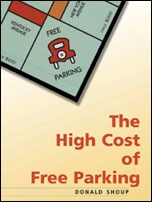
There is no righteous ire like the ire of people who believe they deserve something for nothing. In that light, don't expect many motorists to appreciate Donald Shoup's new book, The High Cost of Free Parking.
An UCLA professor in the Department of Urban Planning, Shoup dissects the economic, social, and environmental impacts of current parking regulations and proposes a new approach that can help free cities from the pernicious effects of auto dependency.
Originally limited to the curbside, parking was destined to become a scarce resource. Cars take up a lot of space, the total area of curbside parking is limited, and certain areas, like workplaces and commercial districts, experience peaks in demand when large numbers of people arrive at once.
Planners concluded that the solution was physical: create enough additional parking to offset the projected increase in demand. What seemed like good public policy at the time has been a slow-motion time bomb for cities. Too much parking is much worse, in the long run, than not enough parking.
When planners calculate how many parking spaces to provide1, they assume parking is free. Obviously, demand for a "free" service will be much higher than demand for a service that must be purchased. If people don't have to pay for parking, they are much more likely to drive.
There's just one problem: parking isn't free. In fact, according to Shoup, "the cost of all parking spaces in the U.S. exceeds the value of all cars and may even exceed the value of all roads." Parking costs billions of dollars a year.
Shoup is an economist, and it shows in the perspective he brings to bear. "[E]conomists do not define the demand for food as the peak quantity of food consumed at free buffets." Nevertheless, planners define the demand for parking as the peak quantity of spaces used when parking is free.
Developers simply pass the cost of "free" parking to property owners, who pass it to tenants, who pass it to all customers in the form of higher prices. "Off-street parking requirements encourage everyone to drive wherever they go because they know they can usually park free when they get there."
Huge expanses of asphalt push buildings far back from the street and away from each other. "Free" parking increases demand for driving lanes, which further separates destinations, making it difficult to get anywhere without a car. This further increases demand for more lanes and more parking in an insidious positive feedback loop.
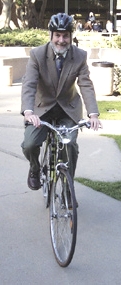
Professor Donald Shoup kindly helps to subsidize your driving expenses
Markets normally use price signals as negative feedback to contain demand. When demand goes up, the price goes up, and the higher price lowers demand. However, for price signals to work, the people using a good or service must be the ones paying for it.
By breaking the relationship between use and payment, "free" parking eliminates the negative feedback that keeps the system in balance. As a result, everyone decides to drive everywhere, and the car crowds out other forms of transportation.
Even paid parking is often underpriced. In Hamilton, for example, motorists can park for 50 cents an hour at most curbside meters.
Assuming about 60 square feet for a parking spot, that's six dollars per square foot per month - an order of magnitude lower than the equivalent monthly cost for a square foot of building space.
The tantalizing promise of underpriced parking leads motorists to cruise around the block until a spot opens up. In studies Shoup cites that analyzed traffic congestion, 30 percent of cars on the road were trying to find a parking spot.
Of all the transport systems available, including public transit, shipping, and rail, cars are unique in that terminal costs (doing something with your vehicle when the trip is finished) are offset to the rest of the economy. This "provide[s] a huge subsidy to motorists, and thus increase[s] the demand for cars, parking spaces, and vehicle travel."
Only walking, which has effectively no terminal costs, is comparable. All things being equal, most people would rather drive than walk. The problem is that all things aren't really equal; parking requirements just make it seem that way.
Worse still, "free" parking provides the biggest per-mile subsidy to the shortest trips, meaning drivers have a major incentive to drive to destinations they would otherwise be able to reach with ease by foot or bicycle.
A huge proportion of traffic congestion is made up these short trips.
Shoup concludes cities should eliminate zoning requirements for off-street parking, end free municipal parking, and charge whatever price will maintain about 15 percent vacancy - the optimal rate to ensure easy entry and exit.
To balance variable demand against a fixed supply, he recommends setting different prices according to time of day and day of week.
Anticipating the righteous ire of those drivers accustomed to free parking, Shoup notes that the biggest barrier to eliminating this subsidy is political, not technical, and proper implementation is critical.
The best way to implement market priced parking is for cities to remit all of the revenues from parking to what he calls "parking benefit districts", akin to business improvement areas. This way, decisions on how to collect and how to spend are made by the citizens most affected.
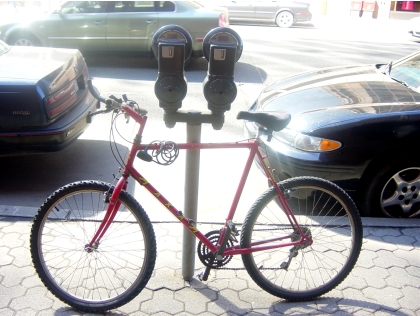
Bicycle parked against a parking meter
The benefits are potentially tremendous: with less parking, there is more room for both people and businesses, and the right balance between supply and demand means less congestion from cruising, less noise, and less air pollution.
Reduced parking requirements also ease entry for investors who might otherwise build elsewhere. As the area becomes more appealing to pedestrians, it attracts both visitors and investors.
For Hamilton in particular, this kind of arrangement can provide the momentum and investment to restore and revitalize our beautiful downtown neighbourhoods that preceded cars and are already designed with pedestrians in mind.
Donald Shoup, The High Cost of Free Parking, American Planning Association, 2005, ISBN: 1884829988
By tom (registered) | Posted July 18, 2006 at 13:22:34
A very illuminating analysis! Likely to be correct on many points indeed. Given that he's probably a socialist to some degree, I'm left to wonder if Dr. Shoup would have the stomach (and the intellectual honesty) to apply his flawless logic to healthcare economics. Agenda driven research, no matter how good, is usually a bad idea.
By Macz (anonymous) | Posted July 18, 2006 at 14:36:53
You should next do an article entitled "The high cost of not being dead"
This would demonstrate unequivocally that respiration is the source of all expenses with the notable exception of opportunity cost (which would be infinite).
By bj (anonymous) | Posted July 18, 2006 at 15:08:30
If my downtown area started charging for parking, the next downtown (5 miles away) would get our business... charging for pakring would have to be implemented in unison across all cities of an urban area.
By aHack (anonymous) | Posted July 18, 2006 at 16:45:59
You write that parking space in Hamilton Ontario costs "six dollars per square foot per month - an order of magnitude lower than the equivalent monthly cost for a square foot of building space."
In what city does office space go for $6/foot per month? It is about $2 per sf per month in downtown San Francisco right now, and that's in American dollars (see http://www.cityfeet.com/Search/Lease/SearchResults.aspx?PartnerPath=&SearchType=byL&GeoId=295&GeoName=%26nbsp%3b%26nbsp%3b-Financial+District&PropertyType=1&PropertyTypeName=Office&SizeMin=0&SizeMax=1000000000000&SizeMinName=0&SizeMaxName=No+Limit&LocationId=254).
Your statement also implies a 500-sq-foot studio apartment would rent for "an order of magnitude" more than $3,000 per month in Hamilton -- wow, expensive town!
By cameldrv (anonymous) | Posted July 19, 2006 at 00:27:32
I don't know where you're getting your lease rates from. Even in New York, office space can easily be had for less than $72/sq foot/yr. Perhaps you are confusing the commonly quoted price for office space as being a monthly rate, when it is a yearly rate. Certainly if one were to rent it out by the month, an unenclosed parking space at $72/ft^2/mo would be extremely expensive.
By Josiah (anonymous) | Posted July 19, 2006 at 00:37:25
John, you have strange math. My car gets 30 mpg average. Gas cost $3 per gallon. This come out to $0.10 per mile. Driving round trip of 10 mi will thus cost $1. If parking is $0.50 per hour, then I would break even in cost by staying where I went for 2 hrs.
Speaking of ignoring the value of time, driving is much faster than walking. I walk at about 4 mph, and can drive at about 40. In a hypothetical walk 1 mile vs. drive 10, the time required either way is the same.
Driving takes less effort and the same time, but costs about a dollar.
By ardil (anonymous) | Posted July 19, 2006 at 06:04:39
"In what city does office space go for $6/foot per month..."
...whereas the article talks about "equivalent monthly cost for a square foot of **building space**"
The confusion is cleared when one realises that every sq.ft. of building space can be converted to potentially many sq.ft. of office space, depending on the allowable floor space index.
By Urban Dave (anonymous) | Posted July 19, 2006 at 08:43:20
Great article. I look forward to reading the book. Sorry that the previous commenters seem to be predisposed to rejecting ideas that they don't yet understand.
I saw a credible statement that a single parking space in a suburban office parking lot cost $1,000 per year. (It cost $1400 to build it, plus maintenance, and the lease cost of the land it sits on.) Coincidentally, that works out to the same price as the downtown parking garage fees that the companies are trying to avoid. It is nice to have the company paying the parking costs.
You see, cars (and the whole world that caters to cars) are a very expensive solution to our transportation needs. There are mountains of hidden costs. The subsidized costs hidden in government maintained roads is much higher. Search for "Cost of driving brochure" to see a pdf showing a TOTAL COST OF $1.19 PER MILE.
(To start: Divide a car's $20,000 price tag by 100,000 miles and you get 20 cents per mile just for paying for a car, its loan, and its maintenance. Gas at $3/gal and 30 mpg adds another 10 cents per mile.)
By Cassie (anonymous) | Posted July 23, 2006 at 22:40:38
Wow! I find it comical that so many people defend so strongly driving their cars for short distances! Amazing. Such practices contribute to pollution, global warming, and in an era of obesity, walking/cycling is such an obviously valuable activity. Let's support the development of walkable communities and better public transit! Those cities are way more fun to liven in than car-dependent cities--I guarantee it.
By SkyForum (anonymous) | Posted December 02, 2006 at 19:21:16
That's an interesting way to stop spammers, LOL "What do you get when you divide 12 by 3"
anyways, on to the topic.
I own a towing company in Denver. I think it's a tremendous article and it has a lot of merit. We have a very successful light rail system all through downtown here. ALL of the parking is pay parking unless it is specifically for someones store. I have many of the accounts for towing for many of these lots. Don't pay? get towed. I end up with your car. It's obvious the idea is to get people out of their cars. I also think there is some rule here that if you buy property in the downtown matrix, you must agree to NOT build another parking lot or you cannot complete the sale.
This seems like a very logical way to deal with Arrogant American and their car.
By nobrainer (registered) | Posted May 29, 2007 at 16:54:23
Nice troll John.
I can afford a car but I choose not to own one because, let's see, (1) they consume non-renewable oil (2) they produce more than half the air pollution in our city (3) they produce greenhouse gases that are causing climate change (4) they are pushing our cities apart so that as you say the places you go get pushed apart to make room for all the damn cars.
It's a chicken and egg problem. When most people have a car we need to rebuild our cities so cars can fit, and the way we rebuild our cities means you need a car to get anywhere.
Sorry that your insecure ego is tied up in being able to afford a car and you can't see that connection. (See? it's easy to be an "armchair psychologist" John)
Maybe if you got out of your car and tried living in a real community--yes, they used to exist, they exist today, and there will be a lot more of them in the future--you'd see that lifes not about wrapping yourself in a big fat dildo with wheels but about placing yourself somewhere you can feel connected and meaningful and more fully human.
Nah never mind. Just turn on the 60'' TV you can afford because you're not a hippy living in mom's basement and drown it all out.
Hi John,
I drive everywhere. I also own my own car and have a job too. And I sometimes, 'harp on about motorists' for RTH too. Amazing eh?!
Sorry to disappoint you mate.
Also, to the best of my knowledge, none of the RTH writers live in their Mums basements or dress like hippies(except Jason).
I was going to answer some of your points but I've just realized I can't be bothered.
Happy driving!
Ben
By highwater (registered) | Posted May 29, 2007 at 17:23:03
You're good John! I don't comb my hair and I spend alot of time in the basement. Doing laundry for my kids mind you, but still.
Of course the rest of the time I'm a soccer mom who likes to "harp on about motorists" on RTH in between driving my minivan and walking to the store.
Anyone have a nice recipe for pie?
By markbarbera (anonymous) | Posted May 30, 2007 at 09:33:49
Hey, John. You are making really baseless assumptions saying that the people who are harping the most about motorists are those who just can't afford a car, and that the harping is more about envy than environmentalism. Our annual household income is in excess of $120,000. We could easily afford a car, but we choose not to. It really is about making wise lifestyle choices. First off, when we went looking fo a home, our criteria included living somewhere where basic ameneties were within walking distance, and public transit was easily accessible. Coincidently, the housing in our area is drastically undervalued, and we purchased our beautiful century home at half the price of a house in the burbs. While we had initial trepidations about living in the downtown area (most media make it sound like it's a crime-ridden wasteland), four years after the move, we actually find our neighbourhood quieter and much more friendly that those of past suburban experiences. As an added bonus, we are saving huge chunks of cash by not making ourselves slaves to the automobile. It's incredible how a car can suck up so much cash every month - and most people allow it to drain their cash like they have no option. Well, you do. And John, because of the choice we made when buying our house, the doctor is around the corner, and the grocery store is up the street. And, my carbon footprint on this planet is much smaller than it used to be. And my wallet is thicker.
You have an extremely limited view of the world, John. Your obvious vindictive bias nearly caused me to laugh off your post, but I thought otherwise, because many buy into the false assumptions propogated in messages similar to yours. So instead, I share my story and encourage others to consider living downtown without a car is a viable option. Car-free living truly is care-free living.
By jason (registered) | Posted May 30, 2007 at 17:09:43
Just got home from riding my bike to work... we own a car but it sat in the drive today. as it does 2 or 3 days a week when I ride my bike or take the bus to work. We too have saved money, but not nearly as much as we could without a car. last time I checked it costs me around $8,000 a year to own my car (we're still leasing). However, since moving downtown 6 years ago (when gas was around 50c a litre) our monthly allotment for gas has gone down...not up. And we drive less km resulting in less wear and tear and (we hope) a longer life for our car once we buy it out after the lease ends. On top of all that, we are in the best physical shape of our lives with all the walking and biking we do....the Market, Locke South, James North, Hess Village, Jackson Square etc...is all within a 10-15 minute walk. We too lived in the suburbs previously and will simply never go back. Living downtown has been amazing.
By highwater (registered) | Posted May 30, 2007 at 22:05:20
ooo. Thanks, Ryan. Clipped and saved for peach season.
You can always do half and half butter and shortening for your crust. I actually prefer cheaper no name shortenings. They seem to make a flakier crust. Higher water content, I think. Just don't forget to chill it first.
Now here's one for you courtesy of Hmag. Impress your friends by cooking with weeds while at the same time helping reduce the noxious garlic mustard that's killing our maple forests and turning our woodland edges into monocultures:
Garlic Mustard Pesto
3-4 cups small garlic mustard leaves (picked early spring) 1/3 c roasted seeds/nuts (I used pine nuts, walnuts would be nice too) 1/3 c olive oil 10 cloves garlic 1/4 c grated parmesan
Process all ingredients in food processor to desired consistency.
This is VERY garlicy. I had some tossed with pasta before choir practise. BIG mistake. They're still not speaking to me. Next time I'll toss in some parsley as well. Also nice on bruschetta mixed with mayo and a little lemon juice, but only to be shared with very close friends.
By PRKGLDY (anonymous) | Posted April 20, 2008 at 10:52:56
I'm fascinated by the rather confused stream of commentary above...mostly on how people choose to address the arguement put forth by Shoup. Each of the above have picked one or two random facts his article to harp on as opposed to addressing the overarching issue. Cities have done a very poor job at planning for parking. I think what's ingenious these days are how people are turning to the web (naturally) for their own solutions in light of the city's lack of adequate planning. Www.parkingspots.com is one that comes to mind pretty quickly - a locator for non-traditional parking solutions at lower then average costs. Once again, consumers are stepping in to take over where municipal planners never fail to disappoint.
By doubting thomas (anonymous) | Posted October 30, 2008 at 02:34:14
After watching Obama's infomercial with Huckstorator supreme Clinton my BS radar is finely honed.
Donald Shoup is a tool manipulating very meager location-specific data and generalizing it not just across a city but across a city. He also fails to note that land saved from parking would not be green; It would be used for more construction further turning cities into canyons. Shoup also fails to realize that consumers will eschew downtowns for strip malls and that parking is the cost for doing business for both businesses and cities. I am NOT going to live in a city where parking is a hassle. Housing values will go down as people flee the city so businesses will have less sales and the city will lose tax revenue. Historically, people have had free parking. It is as American as Apple Pie and the Right to Bear Arms, which Im sure Shoup would go after next. Actually maybe Shoup DOES know ppl will flee cities for suburbs and he is paid by suburban developers to hasten the diaspora or paid by developers to free up more city land for development.
By Public transit software (anonymous) | Posted February 23, 2010 at 01:08:05
*spam comment deleted by site administrator*
Comment edited by administrator Ryan on 2010-02-23 07:12:28
By Mary (registered) | Posted July 22, 2010 at 01:25:50
Count me among the folks who love living walking or biking distance to the essentials--I bike 5 hilly miles to work, can walk to my doctor's office, the grocery store, the library. And it's a mere 30-minutes by bike to see any of my three kids and four grandkids.
The argument that people who ride bikes do it because they can't afford cars (and I know that there are some for whom that is true) reminded me of the guy who said that there are so many people in Amsterdam on bikes because they have a lower standard of living than we do. Come again???
Count me as a 65-year old bike enthusiast (and yes, we are far from car-free in my family). And check out walkscore.com if you want to evaluate just how walkable your next neighborhood is.
By Tartan Triton (anonymous) | Posted September 17, 2010 at 07:28:13
Maybe we can sell some of our parking surplus to Burlington.
http://videos.wittysparks.com/id/1436855823
By slappy (anonymous) | Posted January 04, 2011 at 12:28:17
I would love to bike to work, the grocery store, etc...
Hurdles:
Jobs come and go and you can't always move where the work is.
Living downtown isn't condusive to raising children. "Hey pop, let's go to the park. Sorry son the park takes us 2 hours away."
The doctor down the street is a quack.
The grocery store down the street has roaches.
Broke my arm when my bike I slipped on some ice. Quack down the street reset it wrong.
Must bring a change of close to work
I wish work had a shower so I might wash myself from the sweaty ride over, and not smell when I meet the client for the big project.
Leave home 5:30 to get to work to shower and change by 8:00 Time home: 5:00 + 2 hour bike ride = 7:00. Missed dinner, ah well, maybe tomorrow. Hope the boss doesn't make me stay late.
Where do you people live? Geez, I don't like my car any more than any other environmentalist. But at some point there has to be a line where it's a neccesary evil.
By hammy (anonymous) | Posted January 22, 2011 at 05:46:15
Oh brother, now your gonna tell us all to bike to the game. What is this China? Oh right, they drive cars.
Comment edited by hammy on 2011-01-22 06:00:39
By Tidings (anonymous) | Posted December 28, 2012 at 10:17:25
Two hours of free parking on Concession Street over the Christmas period appears to have gone over well with business owners and their customers.
“It’s been fantastic so far,” said Leo Santos, owner of Papa Leo’s Restaurant last week. “I’ve had a noticeable increase in people being happy that they’re not paying for parking.”
Supported by the Concession Street Business Improvement Area and approved by city council, the two hours of free parking during business hours along the street began on Dec. 10 and wrapped up on Christmas Eve.
There are approximately 140 parking meters on the street.
It’s the first time there has been free parking on Concession Street and the move is expected to cost the city treasury $5,000.
Santos said he’d like to see two hours of free parking throughout the month of December next year.
http://www.hamiltonnews.com/community/free-parking-draws-positive-reviews-on-concession-street/
By kurtzonal (registered) - website | Posted April 11, 2014 at 08:52:22 in reply to Comment 84502
Very well, Istanbul is quit far from this point!!
Thank you for the article, very interesting... Soo, is there any clear result for %15 vacancy?!
You must be logged in to comment.
There are no upcoming events right now.
Why not post one?