Raise the Hammer

If you want to enter this year with a better understanding of the large geopolitical forces shaping such events, you could do much worse than reading this book.
By Ryan McGreal
Published January 27, 2006
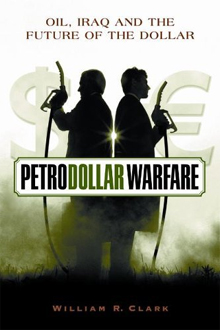
Petrodollar Warfare: Oil, Iraq and the Future of the Dollar
After a winter of overheated rhetorical sparring with Iran, the International Atomic Energy Agency, under duress from the United States, refers Iran to the UN Security Council. America pushes hard for a resolution to order Iran to abandon its nuclear program, but China resists and Russia sits smugly on the sidelines.
US President Bush warns that Iran's actions threaten the security of the United States and its allies, and that Iran's refusal to abandon its nuclear energy program presents a grave and gathering danger. Iranian President Mahmoud Ahmadinejad denounces American hypocrisy and expresses again his desire to wipe Israel off the map.
America threatens a military offensive. In protest, Iran shuts off all oil exports to the west. Oil spikes over $100 a barrel, and Israel launches a missile strike against Iran's uranium conversion facility in Isfahan.
While sitting in line to buy gas at $2.50 a litre, you're scratching your head, wondering what the hell's going on and terrified over what will happen next.
Granted, this is just one scenario among countless possibilities, admittedly chosen for provocation. However, it's as plausible as any, and more than some. So what's really going on?
The common refrain in the news is that Iran seeks nuclear weapons to threaten America and its allies, but some viewers will notice the sharp difference between how America regards Iran and, say, Pakistan or India, two US allies that possess nuclear weapons and refuse to sign the Non-Proliferation Treaty.
Other warning bells go off, like former Secretary of State Colin Powell's warning that Iran is going down the same path as Iraq. TV viewers are sleepy, but they're not entirely comatose, and many will notice they've heard it all before.
Some older readers who recall the Cold War will wonder why the threat of mutually assured destruction (MAD) no longer obtains. Certainly President Ahmadinejad is presented as a madman on network television, but we were always told the Soviet leaders were madmen as well.
If you want to enter this year with a better understanding of the large geopolitical forces shaping such events, you could do much worse than reading William R. Clark's book Petrodollar Warfare: Oil, Iraq and the Future of the Dollar (New Society Publishers, 2005).
Iran's plan to launch an energy trading exchange supports its desire to establish a geopolitical bloc with a Eurasian epicentre, anchored by Iran, China, Russia, and Europe, preferably including India (which is why America is bribing India with nuclear technology).
That threatens the US government's efforts to maintain a unipolar global political economy driven by American consumption and dependent on the centrality of the US dollar.
Clark's thesis is that America's military and diplomatic activities over the past five years are best understood as means of preserving what Clark calls "petrodollar hegemony," or the global system whereby countries must buy oil with US dollars, negotiated with OPEC in the 1970s.
He builds his case carefully, starting with the postwar economic order defined by the Bretton Woods agreement, its unraveling in 1971 when President Nixon reneged on America's promise to redeem US dollars for gold and found a new mechanism in oil pricing to maintain global demand for the dollar.
Clark builds on American power politics with a close examination of the looming peak oil phenomenon and the latest round of powerbrokering to secure access to diminishing hydrocarbon reserves. Then he examines the various ways that America has used its military to protect its geostrategic interests, giving special interest to the manoeuvring that neutralized the UN and made the Iraq invasion inevitable.
But his central premise is that the military actions serve the larger goal of preserving dollar hegemony, now protected by the requirement that other countries buy oil for US dollars. (See my August 2005 essay Iran in the Crosshairs for a more detailed explanation.
Amazingly, analysts on the on the left, who have been following the scent of American imperialism, are meeting up with analysts on the right, who have been tracking American macroeconomics. Both are arriving at the same conclusion: the US economy is headed for serious trouble.
Former Federal Reserve Chair Paul Volcker, who infamously jacked the prime rate up to 21 percent in 1981, now warns of a "75 percent chance of a dollar crash in the next five years."
Asian countries hold approximately $2 trillion in dollars and dollar denominated securities. China has already announced its intention to diversity its foreign asset holdings, and India is considering a similar course.
The Iranian oil bourse could be the pebble that starts an avalanche.Petrodollar Warfare will help you pick through the rubble.
By David (anonymous) | Posted None at
What I find absolutely amazing is a complete lack of discussion on any major media about what is going on here. Even if deception is now the US official public policy (since JFK, actually), the fact that the Central bankers so completely control the media takes the disconnection of our government from the people to new limits. Great site, Ryan - saw you on the Simon Reeve piece - conspiracies:Iraq
By Brian (registered) | Posted None at
This is a great read. A book of such a subject might not be so expected to be the page-turner that it is. And it's hard to find information on these subjects that preceed Clark's book - superb research.
By dave (anonymous) | Posted None at
saw the conspiracies: iraq programme (excellent) and it all fits together. I must admit i'm not a fan of america and the way i believe they conduct themselves (in bed with everyone playing sides off one another) but now they are in real shit and i dont think they saw it coming. At the same time i may sit here and laugh at thier possible demise from power but then what? what would it mean for the rest of the "free" world ? of course i dont believe in a free world it is as a dream as was the idea of rome. Are we headed for a dictatorship? a form of communism or even a democratic regime? who knows but if america do fall i think it will be a greater disaster in the long run for all us who are used to comfort at a distance.
By mikeinindia (anonymous) | Posted February 02, 2007 at 20:10:49
If you are suspicious of the consensus ideas as proclaimed by the media you are deemed an irrelevant nut by the unthinking people of that country. On the other hand many non-Americans probably do suspect the American Govt of a conspiracy to manipulate the world to serve their interests. But to most Americans that doesn't matter much. In a globalised economy with a global media and a global climate problem there is hopefully going to be a global cultural development in response which will mean we will outgrow narrow parochial national interests and their use as tools in our manipulation by the most powerful interests in society. The people who have the most power and wealth have most access to the awesome economic political and intellectual forces which run our world but still these forces operate to a large extent blindly, driven as much by irrational fear, greed and inertia as by enlightened self interest. Mankind has a puzzle to solve which probably can best be tackled by objectivity which is in touch with our highest collective interests. We need a forum for that to be articulated.
By Paul (registered) | Posted July 20, 2007 at 22:07:53
Petrodollar Warfare was a real eye opener. As was Engdahl's book A Century of War. Consider five basic principles surrounding the War in Iraq:
Up until 2000, all OPEC countries sold their oil exclusively in American dollars. That should raise a flag. Exactly why should France have to buy American dollars to buy Iranian Oil?
Before the War in Iraq, oil contracts were largely held by France, Russia, China, Italy and Germnay.
In the fall of 2000 Saddam Hussein switched his oil sales from dollars to euros.
After the invasion, oil sales reverted back to the American dollar.
Afte the invasion, oil contracts were held by American and Britain, the very nations that led the attack.
By Nalliah Thayabharan (anonymous) | Posted September 10, 2011 at 10:25:32
US$, Wars & Earthquakes
By Nalliah Thayabharan
At the end of WWII, an agreement was reached at the Bretton Woods Conference which pegged the value of gold at US$35 per ounce and that became the international standard against which currency was measured. But in 1971, US President Richard Nixon took the US$ off the gold standard and ever since the US$ has been the most important global monetary instrument, and only the US can print them. However, there were problems with this arrangement not least of all that the US$ was effectively worthless than before it reneged on the gold-standard. But more importantly because it was the world’s reserve currency, everybody was saving their surpluses in US$. To maintain the US$’s pre-eminence, the Richard Nixon administration impressed upon Saudi Arabia and therefore Organisation of Petroleum Exporting Countries(OPEC) to sell their oil only in US$. This did two things; it meant that oil sales supported the US$ and also allowed the USA access to exchange risk free oil. The USA propagates war to protect its oil supplies, but even more importantly, to safeguard the strength of the US$. The fear of the consequences of a weaker US$, particularly higher oil prices is seen as underlying and explaining many aspects of the US foreign policy, including the Iraq and Libyan War.
The reality is that the value of the US$ is determined by the fact that oil is sold in US$. If the denomination changes to another currency, such as the euro, many countries would sell US$and cause the banks to shift their reserves, as they would no longer need US$ to buy oil. This would thus weaken the US$ relative to the euro. A leading motive of the US in the Iraq war -- perhaps the fundamental underlying motive, even more than the control of the oil itself -- is an attempt to preserve the US$ as the leading oil trading currency. Since it is the USA that prints the US$, they control the flow of oil. Period. When oil is denominated in US$ through US state action and the US$ is the only fiat currency for trading in oil, an argument can be made that the USA essentially owns the world's oil for free. Now over $1.3 trillion of newly printed US$ by US Federal Reserve is flooding into international commodity markets each year.
So long as almost three quarter of world trade is done in US$, the US$ is the currency which central banks accumulate as reserves. But central banks, whether China or Japan or Brazil or Russia, do not simply stack US$ in their vaults. Currencies have one advantage over gold. A central bank can use it to buy the state bonds of the issuer, the USA. Most countries around the world are forced to control trade deficits or face currency collapse. Not the USA. This is because of the US$ reserve currency role. And the underpinning of the reserve role is the petrodollar. Every nation needs to get US$ to import oil, some more than others. This means their trade targets US$ countries.
Because oil is an essential commodity for every nation, the Petrodollar system, which exists to the present, demands the buildup of huge trade surpluses in order to accumulate US$ surpluses. This is the case for every country but one — the USA which controls the US$ and prints it at will or fiat. Because today the majority of all international trade is done in US$, countries must go abroad to get the means of payment they cannot themselves issue. The entire global trade structure today works around this dynamic, from Russia to China, from Brazil to South Korea and Japan. Everyone aims to maximize US$ surpluses from their export trade.
Until November 2000, no OPEC country dared violate the US$ price rule. So long as the US$ was the strongest currency, there was little reason to as well. But November was when French and other Euroland members finally convinced Saddam Hussein to defy the USA by selling Iraq’s oil-for-food not in US$, ‘the enemy currency’ as Iraq named it, but only in euros. The euros were on deposit in a special UN account of the leading French bank, BNP Paribas. Radio Liberty of the US State Department ran a short wire on the news and the story was quickly hushed.
This little-noted Iraq move to defy the US$ in favor of the euro, in itself, was insignificant. Yet, if it were to spread, especially at a point the US$ was already weakening, it could create a panic selloff of US$ by foreign central banks and OPEC oil producers. In the months before the latest Iraq war, hints in this direction were heard from Russia, Iran, Indonesia and even Venezuela. An Iranian OPEC official, Javad Yarjani, delivered a detailed analysis of how OPEC at some future point might sell its oil to the EU for euros not US$. He spoke in April, 2002 in Oviedo Spain at the invitation of the EU. All indications are that the Iraq war was seized on as the easiest way to deliver a deadly pre-emptive warning to OPEC and others, not to flirt with abandoning the Petro-dollar system in favor of one based on the euro. The Iraq move was a declaration of war against the US$. As soon as it was clear that the UK and the US had taken Iraq, a great sigh of relief was heard in the UK Banks.
First Iraq and then Libya decided to challenge the petrodollar system and stop selling all their oil for US$, shortly before each country was attacked. The cost of war is not nearly as big as it is made out to be. The cost of not going to war would be horrendous for the US unless there were another way of protecting the US$'s world trade dominance. The US pays for the wars by printing US$ it is going to war to protect.
After considerable delay, Iran opened an oil bourse which does not accept US$. Many people fear that the move will give added reason for the USA to overthrow the Iranian regime as a means to close the bourse and revert Iran's oil transaction currency to US$. In 2006 Venezuela indicated support of Iran's decision to offer global oil trade in euro. In 2011 Russia begins selling its oil to China in rubles
6 months before the US moved into Iraq to take down Saddam Hussein, Iraq had made the move to accept Euros instead of US$ for oil, and this became a threat to the global dominance of the US$ as the reserve currency, and its dominion as the petrodollar.
Muammar Qaddafi made a similarly bold move: he initiated a movement to refuse the US$ and the euro, and called on Arab and African nations to use a new currency instead, the gold dinar. Muammar Qaddafi suggested establishing a united African continent, with its 200 million people using this single currency. The initiative was viewed negatively by the USA and the European Union (EU), with French president Nicolas Sarkozy calling Libya a threat to the financial security of mankind; but Muammar Qaddafi continued his push for the creation of a united Africa.
Muammar Gaddafi’s recent proposal to introduce a gold dinar for Africa revives the notion of an Islamic gold dinar floated in 2003 by Malaysian Prime Minister Mahathir Mohamad, as well as by some Islamist movements. The notion, which contravenes IMF rules and is designed to bypass them, has had trouble getting started. But today Iran, China, Russia, and India are stocking more and more gold rather than US$.
If Muammar Qaddafi were to succeed in creating an African Union backed by Libya’s currency and gold reserves, France, still the predominant economic power in most of its former Central African colonies, would be the chief loser. The plans to spark the Benghazi rebellion were initiated by French intelligence services in November 2010.
In February 2011, Dominique Strauss-Kahn, managing director of the International Monetary Fund (IMF), has called for a new world currency that would challenge the dominance of the US$ and protect against future financial instability. In May 2011 a 32 year old maid, Nafissatou Diallo, working at the Sofitel New York Hotel, alleges that Strauss-Kahn had sexually assaulted her after she entered his suite.
On Aug 18 2011, Venezuelan President Hugo Chavez announces a plan to pull Gold reserves from US and European Banks .Venezuela reportedly has the largest oil reserves in the world. Venezuelan President Hugo Chavez has been a strong proponent for tighter Latin America integration - which is a move away from the power of the US banking cartels.
Venezuelan President Hugo Chavez formed oil export agreements with Cuba, directly bypassing the Petrodollar System. Cuba was among those countries that were later added to the “Axis of Evil” by the USA. Venezuelan President Hugo Chavez has accused the US of using HAARP type weapons to create earthquakes.
On Aug 24, 2001 a 7 magnitude earthquake rocks Northern Peru bordering Venezuela which doesn’t use the Petrodollar system and Brazil which has been engaged in discussions to end US$ denominated oil transactions. Is it a coincidence that these uncommonly powerful earthquakes are occurring in historically uncommonly large numbers during such a short period of time?. And that they are occurring in or close to countries that have been seriously discussing plans to leave the Petrodollar system, or are already outside it?
HAARP stands for High Frequency Active Auroral Research Program. It is an ionospheric research program that is jointly funded by the US Air Force, the US Navy, the University of Alaska and the Defense Advanced Research Projects Agency. The HAARP program operates a major Arctic facility, known as the HAARP Research Station. It is located on an US Air Force owned site near Gakona, Alaska. HAARP has the ability to manipulate weather and produce earthquakes. It is capable of directing almost 4 Mega Watts of energy in the 3 to 10 MHz region of the HF band up into the ionosphere. This energy can be bounced off of the ionosphere and directed back down at the earth to create earthquakes. Patents have been applied for discussing such applications. HAARP could potentially be used by adversaries to produce such events.
HAARP based technology is being actively used to emit powerful radio waves that permeate the earth and subsequently cause strong enough oscillations along fault lines of targeted areas to produce earthquakes.
Thigh power radio waves of HAARP can be used to produce such intense vibrations as to cause an earthquake. HAARP based technology can be used to encourage/produce various weather phenomena such as hurricanes, flooding, or drought through manipulation of the ionosphere. Already Russia, China and Venezuela have suggested that a HAARP type technology weapon is capable of such and attack and been used against several countries causing severe destructions in Haiti, Japan, Russia, China, Iran, Chile, New Zealand, Afghanistan, India etc.
What would the probable response be to such an attack be? An armed conflict with the US? Or perhaps something more within reach and even more damaging at this point, the elimination of the Petrodollar system and a subsequent dumping of surplus US$ into the international and US financial markets resulting in the quick collapse of the US$. Attacking these countries with HAARP would destabilize their economies and currencies and to prevent a move away from the US$ and the Petrodollar system.
You must be logged in to comment.
There are no upcoming events right now.
Why not post one?