Raise the Hammer

With a carbon tax, tougher energy efficiency regulations and incentives for innovation in energy production and conservation, we may not be too late to stay ahead of the coming permanent decline in oil production.
By Ryan McGreal
Published January 08, 2009
Syndicated columnist Gwynne Dyer closed his sobering January 2, 2009 piece on US President-Elect Barack Obama's challenges with the following observation:
In January 2008, oil reached the $100-per-barrel mark for the first time. In mid-July it touched $147 per barrel; and by late December it was back down below $50 per barrel. This extreme volatility is exactly what is predicted by most models when we are at or near "peak oil," and it is entirely possible that we are there now. If not, we will certainly be there within a decade.
While oil prices rose steadily over the past several years according to the predictions of peak oil theory, the skeptics, naysayers and deniers scoffed and derided the theory and its proponents as a gaggle of cassandras. (Of course, in the original Greek myth, Cassandra's curse was that she could predict the future but no one would believe her.)
When oil was trading at $40/barrel, no one believed the claim that it would hit $60 per barrel. When oil passed $60/barrel, no one believed it would break $100/barrel. When it shot past $100/barrel, no one believed it would get close to $150/barrel.
And when peak oil theorists warned that persistent high and rising oil prices would destroy demand for oil by triggering a major economic recession, no one believed us then, either.
Yet the arrival of that recession more or less on cue has done little to increase the respectability of peak oil in the mainstream media. With the exception of Dyer, who also wrote about it in his December 23 column, no one in the mainstream is even talking about peak oil anymore.
Instead, if oil is mentioned at all by pundits in the context of the economy, it's to express relief that the falling oil prices of the past half-year are giving consumers a break - as if a renewed incentive to buy gas-guzzling, GHG-emitting SUVs is somehow a good thing.
Some commentators have even suggested that the run-up in oil prices was a chimera, the result of either irrational panic or perhaps deliberate market manipulation by speculators, and that oil prices are now returning to "normal".
The problem with this comforting idea is that there simply isn't any evidence to support it.
If anything, speculators actually helped to smooth oil prices and reduce volatility. Look at this graph from the Library of Economics and Liberty comparing the West Texas Intermediate (WTI) spot price of oil with the inventory levels of crude oil:
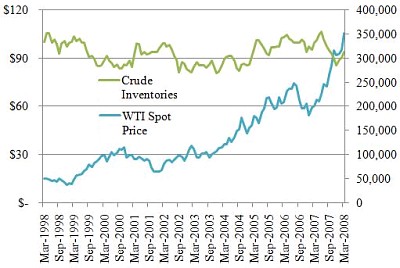
WTI Spot Price compared with Crude Inventories, Mar 1998 - Mar 2008 (Image Source:
Library of Economics and Liberty)
If the price increases were due to speculation rather than demand, the higher prices would encourage the oil industry to produce more oil than the market demanded. That, in turn, would lead to rising crude inventories.
This didn't happen. In fact, as oil prices really took off in 2007, inventory levels actually dropped - exactly what we would expect if the price increase was due to rising demand against a tight supply.
In fact, total global demand for oil has grown steadily since the early 1980s, peaking in mid-2008 at a little over 85 million barrels per day (mbpd):
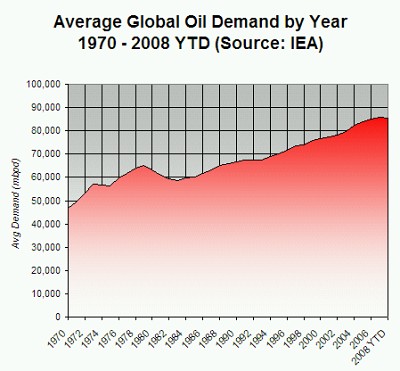
Average Global Oil Demand by Year, 1970 - 2008 (Data source: International Energy Agency)
While global demand has grown steadily, the global supply essentially plateaued in late 2004 and has been flat ever since, with a slight increase in midsummer, when oil prices hit $147/barrel:
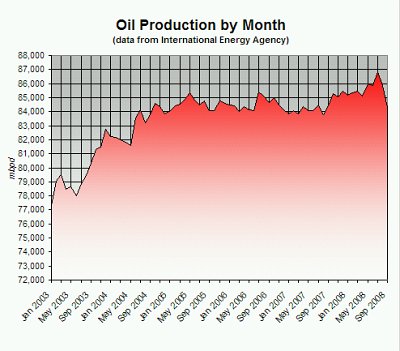
Oil Production by Month, Jan 2003 - Sep 2008 (Data Source: International Energy Agency)
Production has fallen steeply since the midsummer production peak. If we look more closely at 2008 by month, we can see this decline more clearly:
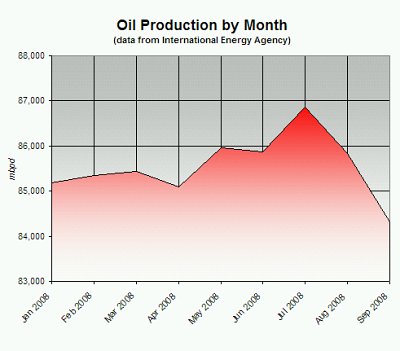
Oil Production by Month, Jan 2008 - Sep 2008 (Data Source: International Energy Agency)
Oil production was over 85 mbpd for the year to date and actually cracked 86 mbpd in July before crashing back down to 84 mbpd by September.
That means it almost perfectly matched demand. Historically, the oil industry has enjoyed a spare capacity cushion of several million barrels per day, with Saudi Arabia acting as the world's swing producer.
The tight coupling of supply and demand, coupled with the movement of crude inventories, tells us the speculators were not just gaming the system to squeeze more money out of it.
Peak oil theory is based on the fact that in a given oilfield, the rate of production increases toward a maximum that generally occurs around the point when half the recoverable oil has been extracted. That point is the production peak, and the rate of production declines steadily after that point until all the recoverable oil is gone.
As a result, production of oilfields follows a bell curve.
You can aggregate the rate-of-production curves of several oilfields - say, all the oilfields in a country - to get that country's production curve.
M. King Hubbert, a geologist working for the Shell Oil Company, established this in 1956 when he did a field-by-field analysis of the USA and predicted that American oil production would peak around 1971 and thereafter go into permanent decline.
That, of course, is exactly what happened.
Since then, other researchers have refined Hubbert's methods and applied them to the world to determine a global production peak.
Most studies place that peak somewhere between around 2005 and 2015, but the data indicate that conventional oil production has already peaked, and the very slight growth in overall production is due to an increase in non-conventional oil, like Alberta's oilsands.
However, once conventional oil starts declining in earnest, non-conventional oil will not be able to increase fast enough to offset those declines, let alone continue to increase overall production.
The "bumpy plateau" is what happens when global oil production has reached its maximum rate but demand keeps growing: the price of oil rises, then super-spikes (as Goldman-Sachs termed it in an April 2005 projection) due to a rapid increase in the marginal cost of production until persistent high prices have destroyed enough demand to bring it in balance with supply.
What ends up happening, however, is that the price spikes so high that the economy goes into recession and demand falls significantly below the maximum rate of production. Oil prices collapse in response.
Sooner or later, low oil prices help to spur a new economic expansion, which leads growth in demand for oil until once again it approaches the maximum production rate, leading to another price spike and another economic crisis.
It looks very much like we are presently going through the first iteration of this "bumpy plateau".
Looked at differently, average daily oil production grew by over 2.01 percent in 2003, 3.45 percent in 2004, 1.71 percent in 2005, 1.35 percent in 2006, and 0.99 percent in 2007; and fell by 0.35 percent in the first nine months of 2008.
Assuming the last three months are as soft as September, 2008 year-end will be down 0.75 percent over 2007, which indicates just how steeply production has dropped in the latter half of the year.
I think we'll see an even steeper annual decline in consumption next year as the global recession deepens. Even rosy analysts have been adjusting their projections downward over the past couple of months.
The International Energy Agency (IEA) is among the most optimistic analysts for the long term, and they have steadily revised their time-line for peak oil downward over the past couple of years. Between 2007 and 2008 they went from dismissing peak oil to claiming that it will happen in 2030.
Then, after questioning by British science columnist George Monbiot, an IEA spokesperson recently admitted that their peak oil estimate is actually 2020, not 2030.
Most oil industry analysts believe the global production peak will happen much sooner. Many believe we are in peak oil right now. The evidence from this year certainly supports that hypothesis, but we won't be able to confirm this for at least another few years. If an economic recovery in, say, 2010 triggers another super-spike in the price of oil followed by another economic crash, it will be very difficult indeed to deny what's happening.
We saw this year what happens when we leave it up to the market to regulate supply and demand: crushing price increases that destroy demand by pricing people out of the market and causing generalized economic recession.
In a more general sense, once oil production starts declining, it will be a perpetual race against time to stay ahead of the decline curve - a 20 year mad scramble in the best of circumstances, and an unmitigated disaster if we leave it up to the unregulated market.
A few years ago, Robert Hirsch was commissioned to write a report for the Pentagon on the strategic threats of peak oil. He concluded that it will take two decades of accelerated effort to convert the US economy to a post-peak system. In his words:
Without timely mitigation, world supply/demand balance will be achieved through massive demand destruction (shortages), accompanied by huge oil price increases, both of which would create a long period of significant economic hardship worldwide.
Translation: during the crisis of transition, millions of people will simply be priced right out of the economy, because they won't be able to afford to consume oil.
A do-nothing, let-the-market-work-it-out strategy would be a disastrous way to prepare for the next few decades. Doing this would cause tremendous harm and misery as rapidly see-sawing prices send chaotic, conflicting market signals to consumers that would delay the transition of our economy away from dependence on oil.
Despite his acknowlegement of peak oil, Gwynne Dyer is still something of an optimist - he accepts the IEA's 2020 time-line for peak oil. His January 2 warning about oil price volatility ended on a positive note:
[Peak oil] does not necessarily mean regular oil shortages and permanently high prices, because a parallel down-shift may be getting under way in the demand for oil.
The United States is about to get serious about greenhouse gas emissions, and that means that U.S. oil use is going to fall.
A lot of other countries are already on that track, and more will follow. If they all get it right, then oil will be neither scarce nor expensive - and nobody will care much about it anyway.
That's a lot of big ifs, and if the US and the industrialized world don't get very serious about cutting oil consumption, we could still be in for up to two decades of unremitting economic chaos.
At the very least, we need to get serious about some kind of carbon tax that establishes an effective price floor for oil. This would accomplish the following:
Reduced volatility - for businesses trying to plan their operations, stable high prices are easier to deal with than wildly volatile prices.
Induced innovation - As Richard G. Newell et al. demonstrated in an important 1999 study (PDF link), higher energy prices, coupled with product-labeling requirements and energy-efficieny regulation, drive increases in the average energy efficiency of consumer products.
Price Signals for Conservation - With an income tax, the only legitimate way to reduce how much you pay is to sock more money into an RSP or to reduce your income. With a shift to carbon taxation, if you want to reduce the tax you pay, all you need to do is emit less carbon.
Sweden, Finland, Norway and the Netherlands implemented fairly steep carbon taxes in the 1990s, and have enjoyed strong economic growth coupled with falling per capita and overall oil consumption.
This is encouraging. With a robust carbon tax, tougher performance-based regulations for energy efficiency and incentives for innovation in energy production and conservation, we may not be too late to stay ahead of the coming permanent decline in oil production until oil is no longer the foundation of our economy.
However, we'll never get there until we shake off our denial and recognize why our economy is in turmoil. If we let falling oil prices lull us into a new round of SUV purchases and big suburban homes, we will squander our last-ditch opportunity to avoid getting locked into a decaying spiral of economic chaos.
By cliffordwirth (anonymous) | Posted January 09, 2009 at 09:04:56
This is an excellent article. Unfortunately, it is too late for conservation to do much good, as explained below.
The top story of the year is that global crude oil production peaked in 2008.
The media, governments, world leaders, and public should focus on this issue.
Global crude oil production had been rising briskly until 2004, then plateaued for four years. Because oil producers were extracting at maximum effort to profit from high oil prices, this plateau is a clear indication of Peak Oil.
Then in August and September of 2008 while oil prices were still very high, global crude oil production fell nearly one million barrels per day, clear evidence of Peak Oil (See Rembrandt Koppelaar, Editor of "Oil Watch Monthly," December 2008, page 1)
Peak Oil is now.
Credit for accurate Peak Oil predictions (within a few years) goes to the following (projected year for peak given in parentheses):
* Association for the Study of Peak Oil (2007)
* Rembrandt Koppelaar, Editor of “Oil Watch Monthly” (2008)
* Tony Eriksen, Oil stock analyst and Samuel Foucher, oil analyst (2008)
* Matthew Simmons, Energy investment banker, (2007)
* T. Boone Pickens, Oil and gas investor (2007)
* U.S. Army Corps of Engineers (2005)
* Kenneth S. Deffeyes, Princeton professor and retired shell geologist (2005)
* Sam Sam Bakhtiari, Retired Iranian National Oil Company geologist (2005)
* Chris Skrebowski, Editor of “Petroleum Review” (2010)
* Sadad Al Husseini, former head of production and exploration, Saudi Aramco (2008)
* Energy Watch Group in Germany (2006)
* Fredrik Robelius, Oil analyst and author of "Giant Oil Fields" (2008 to 2018)
Oil production will now begin to decline terminally.
Within a year or two, it is likely that oil prices will skyrocket as supply falls below demand. OPEC cuts could exacerbate the gap between supply and demand and drive prices even higher.
Independent studies indicate that global crude oil production will now decline from 74 million barrels per day to 60 million barrels per day by 2015. During the same time, demand will increase. Oil supplies will be even tighter for the U.S. As oil producing nations consume more and more oil domestically they will export less and less.
Because demand is high in China, India, the Middle East, and other oil producing nations, once global oil production begins to decline, demand will always be higher than supply. And since the U.S. represents one fourth of global oil demand, whatever oil we conserve will be consumed elsewhere. Thus, conservation in the U.S. will not slow oil depletion rates significantly.
Alternatives will not even begin to fill the gap. There is no plan nor capital for a so-called electric economy. And most alternatives yield electric power, but we need liquid fuels for tractors/combines, 18 wheel trucks, trains, ships, and mining equipment. The independent scientists of the Energy Watch Group conclude in a 2007 report titled: “Peak Oil Could Trigger Meltdown of Society:”
"By 2020, and even more by 2030, global oil supply will be dramatically lower. This will create a supply gap which can hardly be closed by growing contributions from other fossil, nuclear or alternative energy sources in this time frame."
With increasing costs for gasoline and diesel, along with declining taxes and declining gasoline tax revenues, states and local governments will eventually have to cut staff and curtail highway maintenance. Eventually, gasoline stations will close, and state and local highway workers won’t be able to get to work. We are facing the collapse of the highways that depend on diesel and gasoline powered trucks for bridge maintenance, culvert cleaning to avoid road washouts, snow plowing, and roadbed and surface repair. When the highways fail, so will the power grid, as highways carry the parts, large transformers, steel for pylons, and high tension cables from great distances. With the highways out, there will be no food coming from far away, and without the power grid virtually nothing modern works, including home heating, pumping of gasoline and diesel, airports, communications, and automated building systems.
It is time to focus on Peak Oil preparation and surviving Peak Oil. Clifford J. Wirth, Ph.D. clifford dot wirth at yahoo
survivingpeakoil.blogspot.com/
peakoilassociates.com/POAnalysis.html
By gullchasedship (registered) - website | Posted January 09, 2009 at 10:38:22
The same things happen to meat prices. Does that mean we have "peak meat"?
By Chris (registered) | Posted January 09, 2009 at 11:38:21
Why is it that so many environmentalists support the notion that a carbon tax is a good and even necessary thing? All taxes are borne disproportionatly by the middle and -middle classes simply because they can not escape them. Governments have to do this because tax loads placed on individuals or corporations with foreign investment or foreign mobility options can simply relocate themselves or their capital to another country state or province. Political influence by such further seals that deal. It is a sad fact of life that those with the fewest financial resources will bear the cost of this and virtually every other tax as it is passed along in the form of price increases on goods even if a tax does manage to be implemented on a provider of the now taxable good or service. Why is it that so many on the left still believe that taxes will somehow be borne by those who can "afford" it.
By A Smith (anonymous) | Posted January 09, 2009 at 13:53:06
Ryan, any decrease in consumption of oil that comes from a carbon tax will only result in higher consumption in other countries. Therefore, if the aim of a carbon tax is to conserve oil, (assuming that it needs to be conserved in the first place) unless you can introduce it world wide, it will not work. All that will happen is that U.S. consumers will use more oil, have more disposable income and a higher standard of living than they do today. In Canada, we will have higher energy costs, less disposable income and a lower standard of living. How is this a good idea?
By Chris (registered) | Posted January 09, 2009 at 14:41:00
In response to the posting by Clifford Wirth. There is some speculation that oil production will peak in the first half of this century. That is all it is - speculation. OPEC was formed to control production and prices by its members. Production rises and falls mostly to control price, when you see the production of oil dip when prices are high it is to maintain the peak price not because the oil has run out or the sky is falling. I believe in what you are doing though Cliff, fear sells and always has. Good luck with your ruse - you drop enough names implying they support your contention that production of oil has peaked that those who do not conduct their own research may actually be taken in for a while. I too believe you could convince enough gullible people that the sky is falling to extract a decent living and then some from the new survivalists you hope to inspire. Clifford Wirth is a notorious spammer and fake who undermines REAL environmental science. Satisfy any curiosity you might have concerning this scam artist and search using his name + fraud.
By Chris (registered) | Posted January 09, 2009 at 15:00:07
In response to the posting by Clifford Wirth. There is some speculation that oil production will peak in the first half of this century. That is all it is - speculation. OPEC was formed to control production and prices by its members. Production rises and falls mostly to control price, when you see the production of oil dip when prices are high it is to maintain the peak price not because the oil has run out or the sky is falling. I believe in what you are doing though Cliff, fear sells and always has. Good luck with your ruse - you drop enough names implying they support your contention that production of oil has peaked that those who do not conduct their own research may actually be taken in for a while. I too believe you could convince enough gullible people that the sky is falling to extract a decent living and then some from the new survivalists you hope to inspire. Clifford Wirth is a notorious spammer and fake who undermines REAL environmental science. Satisfy any curiosity you might have concerning this scam artist and search using his name + fraud.
By Chris (registered) | Posted January 09, 2009 at 15:00:26
In response to the posting by Clifford Wirth. There is some speculation that oil production will peak in the first half of this century. That is all it is - speculation. OPEC was formed to control production and prices by its members. Production rises and falls mostly to control price, when you see the production of oil dip when prices are high it is to maintain the peak price not because the oil has run out or the sky is falling. I believe in what you are doing though Cliff, fear sells and always has. Good luck with your ruse - you drop enough names implying they support your contention that production of oil has peaked that those who do not conduct their own research may actually be taken in for a while. I too believe you could convince enough gullible people that the sky is falling to extract a decent living and then some from the new survivalists you hope to inspire. Clifford Wirth is a notorious spammer and fake who undermines REAL environmental science. Satisfy any curiosity you might have concerning this scam artist and search using his name + fraud.
By A Smith (anonymous) | Posted January 09, 2009 at 17:07:24
Ryan, I have no doubt that human beings will come up with alternatives to oil if and when it runs out, but until it does, why should we make life harder on ourselves than we have to? You mention that Sweden and other European countries have managed to grow their economies while cutting back on oil consumption, that's true, but not as fast as North America. Furthermore, most of the economic growth European countries have shown in recent years has been because of the low corporate tax model introduced by Ireland. This development has led to increased capital investment in Europe and is one of the reasons why the Euro has been as strong as it has been in recent years.
Currently, North America has corporate tax rates about 10% higher than European countries. If you brought these rates down to European levels, we would be growing much faster than they currently are.
I am not arguing that carbon taxes would drive us back into caves, but neither would allowing the market to function. If we just let people choose what the market gives us, things will work out automatically. If oil jumps over $100 again and stays there for a few years, alternative energy will compete quite successfully, without the need for any government intervention. If it doesn't, then people will benefit from cheap inputs, thereby increasing their disposable income.
However, by setting a floor on the price of oil, you guarantee that people will suffer from high oil prices. At least by letting the market work freely, you increase the possibility that this may not be the case.
By A Smith (anonymous) | Posted January 09, 2009 at 17:41:33
Ryan, have you considered what reducing our oil consumption would do to the Royal family in Saudi Arabia? You selfish bastard.
By cjwirth1 (anonymous) | Posted January 11, 2009 at 10:49:50
@ CHRIS,
In the comment above, I cited many scientific reports. Instead of examining the issue, you make a personal attack, using Nazi tactics to try to discredit me. If you Google: "peak oil impacts" my report will come up: peakoilassociates.com/POAnalysis.html
where there are many fact.
Try to deal with the facts.
In August and September of 2008 while oil prices were still very high, global crude oil production fell nearly one million barrels per day, clear evidence of Peak Oil (See Rembrandt Koppelaar, Editor of "Oil Watch Monthly," December 2008, page 1
www.peakoil.nl/wp-content/uploads/2008/12/2008_december_oilwatch_monthly.pdf.
Peak Oil is now.
Credit for accurate Peak Oil predictions (within a few years) goes to the following (projected year for peak given in parentheses):
* Association for the Study of Peak Oil (2007)
* Rembrandt Koppelaar, Editor of “Oil Watch Monthly” (2008)
* Tony Eriksen, Oil stock analyst and Samuel Foucher, oil analyst (2008)
* Matthew Simmons, Energy investment banker, (2007)
* T. Boone Pickens, Oil and gas investor (2007)
* U.S. Army Corps of Engineers (2005)
* Kenneth S. Deffeyes, Princeton professor and retired shell geologist (2005)
* Sam Sam Bakhtiari, Retired Iranian National Oil Company geologist (2005)
* Chris Skrebowski, Editor of “Petroleum Review” (2010)
* Sadad Al Husseini, former head of production and exploration, Saudi Aramco (2008)
* Energy Watch Group in Germany (2006)
* Fredrik Robelius, Oil analyst and author of "Giant Oil Fields" (2008 to 2018)
By LL (registered) - website | Posted January 11, 2009 at 23:35:54
Chris wrote:
"Why is it that so many on the left still believe that taxes will somehow be borne by those who can "afford" it."
I don't know what you mean by "the left". Perhaps you are one of those Fox News enthusiasts who considers centrists and corporate environmentalists to be left. But as someone familiar with the left milieu in Canada, I can say that the ACTUAL left (social democrats, social anarchists, marxists, etc.) generally opposes carbon taxes as regressive (ie., they harm workers and poor people disproportionately), which is basically the argument you made.
I have been trying to take issue with that position, and argue instead that carbon tax is at worst a vice tax, and at best a progressive measure which would ultimately contribute to more social equality, assuming the proceeds are pumped back into cities for transit and other grassroots programs.
My reasoning is largely an inversion the argument Ivan Illich laid out in his classic essay, Energy and Equity, as well as some of his other writings. In a nutshell, Illich argued that, beyond a certain threshold, a high energy flow through a society produces inequality by FORCING the rich and poor alike to consume industrial outputs.
To illustrate: imagine being a low wage worker in a totally sprawled out city like Atlanta or Phoenix. You can't afford a car but you need a car. It's simply not a luxury or an individual choice no matter how many times you tell yourself (and the commercials tell you) you love it. (Sorry A Smith.) Now imagine being a low wage worker in Amsterdam or Copenhagen, where most jobs are easily accessible by bike.
Illich called this lack of choice a radical monopoly - when industrial outputs become mandated. You can do little things like ride a bike and garden and buy local. But ultimately you can't just "individually" choose as a "consumer" to live a low impact way. It takes collective social and political action to bring this possibility about.
Energy and Equity is available free if you google it.
By LL (registered) - website | Posted January 12, 2009 at 00:23:32
Just a note on my last post:
A Smith reiterated a comment made by many right-wing pundits about how a carbon tax would reduce our standard of living. I don't know if this is true or not, but it's not really the point as far as I'm concerned. Since it recovered from the last oil shocks, North America has maintained an extremely high standard of living - possibly the highest in the world. But the quality of life has been severely degraded. I'm talking about a long work week(and growing, despite "time-saving" technologies), an overly fast pace of life, an unhealthy diet, media saturation, advertising overload, traffic congestion, ugly cities, a lack of public space, a lack of personal choice in transportation modes, communities torn apart by inequalities... If a reduction in energy intensity of the economy is handled in a socially conscious and class conscious way, I think it can produce all kinds of benefits.
As we debate carbon and other ecological issues in the coming decades, I think we need to acknowledge the distinction between standard of living and quality of life. I think that we should work to live, not the other way around. Most discourse assumes the opposite. I think that's a big ideological barrier to social progress.
By David (anonymous) | Posted January 12, 2009 at 14:37:05
The Carbon Tax idea might look good on paper, and might work in countries small enough to walk across for groceries. But the US still has their 3000 mile Ceasar Salads. Cities made the mistake of adapting to "somewhere else" supplying their needs, then pulled up the rails. Truckers are dropping like flies - too many chasing too few loads has dropped profits to near zero, while fuel soared. The calamity of no food or toilet paper deliveries to big cities is likely even before someone proposes to kill the truckers off totally with carbon taxes.
If we have reached "peak everything" due to the collapse of debt which kept previous prosperity on life-support, the carbon "problem" (the science against is a highly spiked story)... will be self-limiting. The scrubbers (trees) will grow back where the factories used to be. I believe we are headed toward a much lower standard of living, and basic survival will displace environmental concerns.
By Curacao (anonymous) | Posted January 13, 2009 at 23:03:50
Awesome discussion in the comments section of "Automatic Earth blog yesterday (January 12).
Fascinating ideas about how the volatility in oil prices contributed to the terrible behavior of Wall Street.
Check out the posts Theramus and Weaseldog there.
By curacao (anonymous) | Posted January 13, 2009 at 23:07:10
Link for Automatic Earth blog ref in previous post.
theautomaticearth.blogspot.com/2009/01/january-12-2009-i-aint-got-no-home.html
By curacao (anonymous) | Posted January 14, 2009 at 08:20:22
Link for Automatic Earth blog ref in previous post.
theautomaticearth.blogspot.com/2009/01/january-12-2009-i-aint-got-no-home.html
By Chris (registered) | Posted January 14, 2009 at 12:53:00
Re LL's post concerning the "left" support for carbon taxes and taxes in general. A lot must have changed since I was involved in leftist politics. When I was active in that area taxes were viewed as the prime means of redistribution. The idea being that the "rich" and "business" were laughably going to pay the lions share of such in a society that was going to equalize incomes to a degree and provide needed services with the revenue. This was a long time ago so I will take your word that the current crop of reds is more selective of the taxes they support. In response to A Smith you state "If a reduction in energy intensity of the economy is handled in a socially conscious and class conscious way, I think it can produce all kinds of benefits." That is exactly the type of statement I would have expected from a number of people on the left that I knew, I might have even made such a statement myself. It is based on a laughable fallacy; the idea that it would be handled in a class conscious way. When has that ever been done? It happens all the time but not in the way you mean. It will amaze and astound you just how wealthy a government considers you to be when it rolls out a new tax. There is one cash cow to milk and it is the one that can't run away (move or invest elsewhere) or move money around to avoid taxation ie increased RRSP or tax sheltered investment loop hole created to appease higher income earners. Regardless of who takes control of the political machine that is the way it is. I do not know of a party or even a politician with the will to change that do you? Until someone makes a lot of noise followed by some convincing action that they are going to insure that taxation for a start is handled in a socially conscious and class conscious way all the time EVERY time, the current political apathy as evidenced by declining voter turnout will continue. Apathy out of ignorance? Just the opposite the informed cyncism I encounter from young to old indicates to me that people just can't be bothered voting for yet another stooge who's self interest will trump all, or another party who thinks re-inventing themselves means changing T shirts.
By Chris (registered) | Posted January 14, 2009 at 13:34:07
Re Clifford Wirth accusing me of "Nazi" tactics. Interesting comment Cliff old socks. My grandmother was Jewish but I suppose there are some Jewish nazi's; talk about self loathing or schizophrenia. One of the first things I noticed about your site was how it took just a few clicks to link to Peak Oil Fascists and UFO Conspiry Theorists. I think your links to nazis are a lot closer than mine. White supremacists seem to be fond of your work as it gives them their only hope they may some day come to power. I concluded my brief analysis of your work by urging anyone who has any doubts that you are simply riding the crest of the latest fear wave to check you out themselves and to do their own research into peak oil as your information is tainted by self interest. I stand by that as I stand by my contention that you are a fraud who is hoping to attract and exploit a new wave of survivalists. I really like the way you have people listed as your "Followers". How unpretentious of you I would have thought a man of your stature would be refering to them as his disciples. Good luck with your scam Cliff.
By LL (registered) - website | Posted January 14, 2009 at 22:02:08
Chris wrote:
"When I was active in that area [the left] taxes were viewed as the prime means of redistribution."
I don't know what group you were involved with, but from my understanding (and I have studied quite a bit of history), the left has always distinguished between progressive and regressive taxation. The carbon tax could be seen as a "flat", and thus regressive, tax because it would affect poor and working class disproportionately through higher cost of consumer goods. Here in Canada, neither the NDP, nor the two marxist-leninist parties have supported a carbon tax. But they have addressed the carbon problem in their own ways.
Sorry moderators, I know it's off topic, but some basic education is needed for me to respond to Chris' claims.
In the Cold War, the political spectrum was simplistically caricatured as having one axis, from left to right. In reality there are at least two axes: one from left to right, and one from authoritarian to libertarian. That's why Ayn Rand and Adolf Hitler (to use two extreme examples) are both "right-wing" but actually have very different views.
Similarly, the left has an authoritarian (Mao, Lenin etc) and libertarian spectrum (Emma Goldman, Noam Chomsky, Murray Bookchin). 100 years ago, the libertarian left (the classic anarchist and syndicalist movements) was arguably bigger in numbers than the Communist and Social Democratic movements. But in the hubbub of the Russian Revolution and the Cold War, the libertarian left was sort of forgotten.
Now it's back. The radical scene today has a definite social anarchist streak. This is the perspective I'm coming from. I think economics and politics need to be from the ground up and defined by direct and participatory processes. Ultimately, the phenomenon of an armed organization (the state) requisitioning the fruits of peoples' labour (taxes) by force needs to go. But I also believe profits are a form of "taxation" on the workers.
That's my left. I'm also cynical about changing things through elections. Reforming the state and capitalism is ultimately futile. Change has to come from the ground up.
However, as an adult with a firm grip on reality, I maintain that social movements have to mediate existing realities. That's why I tentatively support a carbon tax, as long working class people get a corrolary income tax break, and as long as revenues are pumped back into cities for transit. (Ensuring more transparant and participatory governance in municipalities is up to citizens and is a longer term process.)
Mass motoring and sprawl are not only major contributors to climate change and resource depletion. They excascerbate the inequalities produced by capitalism. That's why I don't think a carbon tax is necessarily regressive.ism in an extremely small nutshell.
By A Smith (anonymous) | Posted January 14, 2009 at 23:21:53
LL, profits represent the value people/businesses add to society. Nothing more, nothing less. Furthermore, without profits, businesses are unable to expand their offerings to customers, which doesn't help anyone in the long run.
If your argument is that profits could be distributed to employees rather than go to the owner, that is true. However, since employees don't risk going bankrupt like investors do, they also shouldn't be allowed to reap the rewards that comes through taking great risks.
In our country today, no one is barred from starting a business, so there is no excuse for not getting rich. If someone wants to get wealthy, all they have to do is give customers something of value.
By LL (registered) - website | Posted January 15, 2009 at 00:33:35
"A", we obviously have strikingly different views on economics, so I'm not going to debate them with you at length. After all, this thread is supposed to be about oil prices.
Briefly, I refuse to believe that the money that the bosses make represents value they've contributed to the economy. (I meant "profits" in the broad sense.) The exchange of labour for a wage is an exploitative one. To me, the notion that in the "free market", there are no classes, strata, or castes - just individuals with differing merits - is a completely naive fantasy.
So, I agree broadly with Marx' notion that labour creates value, and some of that value is "expropriated" by the owners and controllers of capital. And that's what creates the class system.
However, on a more fundamental level, I think value can be looked at in different ways, and economics in general can be problematic. I think a lot of value (economic and otherwise) is embedded in ecosystem processes that function on a completely different timescale to human society.
Fossil fuels were created roughly 80 million years ago - the remnants of organisms. The energy that's embedded in them is essentially a huge store of solar energy. These gifts of natural history are extremely useful substances - the basis of much material culture today. Capitalism might not be able to conjure a replacement. And we're burning them away - disrupting the whole energy cycle of the planet in the process. For what? A transportation system that's objectively inefficient.
By A Smith (anonymous) | Posted January 15, 2009 at 12:29:50
LL, I totally agree that business owner's get more from their employees than they give back. However, this is not unique in nature. Parents give more to their children then they get back and yet if this wasn't the case, none of us would be around. Furthermore, there is nothing stopping a group of individuals from forming a co-op, where the workers share in 100% of all surplus. Over time, if this arrangement creates the happiest, most productive employees, then they should take most of the market share from companies that "exploit' their workers. Therefore, over time, the market rewards those companies that strike the right balance between rewarding employees, and rewarding those who supply capital.
Moreover, how do you explain the fact that many companies go out of business. The reason why this happens, is because workers get paid too much. In this scenario, the goods offered to the public only bring in a percentage of what it costs to pay employees to make them. Therefore, in these cases, the worker is exploiting the business owner.
Then there is the relationship between customer and business owner. Since in aggregate, customers never pay more for a product than it is worth to them in utility, it is the business owner that gets screwed over by the consumer. However, since most consumers are also employees, any exploitation that took place in the first relationship, is likely counteracted to an even greater extent by this relationship.
Then there is the question of what is exploitation. Is it simply the fact that employees don't retain 100% of all of their efforts, or is it something else? For example, is it preferable to work for a company that earns 5% more every year, but pays its employees 99.9% of all income. Or is it better to work for a business that pays its employees only 80% of their labour, but that grows at 10% per year. Over time, the numbers indicate that the employee willing to allow the owner to keep more in profits will do better.
Lastly, in a free society, where individuals are allowed to enter into contracts voluntarily, we should expect people to enter into all sorts of agreements that others may deem as being exploitative. However, by outlawing what appears to be exploitative to politicians, we lose focus on what really matters and that is freedom. If government bans people from entering into contracts that both sides deem is fair, they have reduced the overall satisfaction in society, which contradicts the goals that they are trying to promote.
By Curacao (anonymous) | Posted January 18, 2009 at 13:31:47
Data on oil price volatility fro 1986-2009 and a discussion of the implications of this volatility can be found @ ideas.wikia.com/wiki/User:Therramus.
By LL (registered) - website | Posted January 19, 2009 at 12:20:54
The first thing I would like to stress is that I never claimed ALL economic value comes from labour. I think much economic value comes from ecological processes that originate outside of human activity. That's an important point for petroleum. But it also applied for soils, forest products, clean water, etc. This is probably a more central point to me.
I like this blog for the civic focus. But I'm often turned off by the endless economic debates: does "free market" capitalism or "regulated" capitalism create more growth. Yawn... Both arrangements are adept at producing growth. Capitalism under fascist regimes produced growth. Stalin's 5-year plans produced tremendous growth, transforming Russia from agrarian to industrial virtually overnight.
The point is that all of these systems are based on social relations of hierarchy and domination. None of them have produced a free society. All of them have contributed to destruction of the biosphere.
I think ALL economistic notions of value are deeply problematic; I think value is relative to your social purpose. I merely invoke Marx's labour theory of value for the limited question of who's getting ripped off in society. I think too much ideological focus is put on taxes. Too much attention is paid to the salaries of public sector execs while the much bigger spoils of corporate execs are conveniently ignored. These two groups do the same work. Meanwhile, it's entirely possible to do away with both: any time a large-scale example worker self-management (aka, soc'ialism) has been allowed to thrive, the workers perform the same coordinating function - just fine - through democratic processes.
Ryan: I appreciate your thoughtful comment and your article. There is much to think about there. Yet I'm rather unclear on what you mean by "knowledge embedded in labour". Is "embedded knowledge" knowledge that has been created in the past? If so, let us assume that it was created through thinking, reading, experimenting, researching, tinkering, teaching, writing, etc. Are these activities not forms of work? If so, and if they contribute to profit and capital accumulation, are they not just a specific form exploited labour? I'm a little rusty on labour theory these days. But I know the marxist tradition has had a lot to say about intellectual work.
As a friend of mine in the labour movement likes to say: "workers aren't just white guys in overalls."
So I generally agree with you that intellectual and technical work creates a great deal of economic value. And I would say that white collar workers are often NOT given a fair salary for the hard work they do. (I should know.) But you seem to be suggesting that ONLY intellectual workers create surplus value. If so, I would have to disagree. The mere notion seems to carry technocratic implications, as if giving skilled workers an exclusive stake in the system would bring about social justice. This is not surprising. One of the weaknesses I find with the new urbanist and Green Party type scenes is a strong technocratic streak that hasn't been held up to enough scrutiny (at least not on this site.) Correct me if I'm wrong.
It's an easy fallacy to make in these days of the "knowledge economy," when the economy of advanced capitalist nation-states has been "de-materialized." But knowledge, as far as the property system is concerned, is essentially a form of CAPITAL. Like any form of capital, living where knowledge has accumulated to a great degree allows even working class people to have a higher standard of living. But that goes for any form of capital. It's the basic reason why a coffee farmer in Ethiopia works a lot harder than a steel worker in Hamilton, but makes less money. (Check out Immanuel Wallerstein's World Systems theory.)
You're right that knowledge and information are harder to control than more material forms of capital. (Hence the strenuous legal effort to artificially maintain entertainment products as a scarce commodity.) In that sense, the creation of non-proprietary software is potentially revolutionary. So is file sharing. That's why I'm concerned about the "net neutrality" debates.
By A Smith (anonymous) | Posted January 19, 2009 at 15:25:38
LL, without smart individuals, the resources of the environment offer nothing more than what they have since time began. That is why Japan is much richer than Russia. While Russia was still the U.S.S.R, they decided that building bombs and nuclear weapons was more important than allowing individuals to decide what was important. As a result, this centrally planned Marxist utopia created the worst environmental landscape the world has ever seen. In, contrast, Japan, turned a nation with few natural resources into the second largest economy in the world.
You mention that value is relative to the social purpose, I disagree. Value is measured by how much people are willing to pay over and above what it takes to produce the good or service being offered. Since everybody recognizes that money doesn't grow on trees, when it is spent, it is done so as to maximize the utility in the spenders life. Therefore, if a person values the natural environment more than anything else, he/she will derive great value from a trip to the Amazon. To the extent that others feel the same way, profit seeking companies will ensure that consumers are able to enjoy this adventure for as long as they are willing to pay for it. In this case, business simply reflects the values that consumers have, as reflected in their personal spending decisions.
Furthermore, value can't be produced over the long term without focus on the individual. Since a nation is nothing more than a collection of millions of individuals, each trying to live the best life they can, any attempt by planners to create value for the average person is nothing more than a wild guess. In fact, the "average person, or "average Canadian", doesn't exist. There is only Jane S., Bill N., Amy K., etc. Each one of these people spends their money in order to maximize its utility and in so doing, they do what no central plan can ever do, namely to produce an enormous diversity of goods and services.
Over time, this economic diversity stops us from making huge bets that fail to return value to the capital employed and it also keeps on on the cutting edge of technology and innovation. Compare 1988 U.S.S.R to 1988 U.S.A and you can see the benefits of allowing the consumer to control the bulk of spending decisions in the economy. In the former, production was based on the imaginations of a few chosen people, whereas in the U.S., production was based on the choices and inventions of millions of people.
Therefore, it should be no surprise that harnessing the power of millions of micro-planners was much more efficient than leaving all production decisions to a tiny fraction of this number. The world is simply to complex to allow a few people final say on what is needed and furthermore, what is wanted.
By LL (registered) - website | Posted January 23, 2009 at 18:04:26
So you think the value of the whole Amazon basin is only equal to the amount "eco-tourists" are willing to spend on it? I'm assuming most RTH readers see the immediate stupidity of that statement. But just in case, I'll explain a few things: the Amazon has been around for 55 million years. Humanity (depending on how you define it) has been around for about 500 000 years. Its questionable whether humanity, let alone capitalism (about 500 years old), would have developed in its present form without the Amazon. It plays a huge role in regulating the climate and atmospheric composition of the planet. People in all corners of the world benefit economically from "ecosystem services" of the Amazon. And as far as ecotourism goes, it's not that interesting. The topography is flat and you can see much more biodiversity much easier in Costa Rica (and go surfing afterwards.)
I don't know how your ethical system values whole species. But what about the native people who live there? If they can't come up with the capital to outbid logging companies, I suppose they just get bulldozed. That must be the glorious freedom and liberty that the market provides.
Do you even read the posts you're supposedly critiquing, or do you just skim them?
I've been a far more consistent critic of centralization and political parties than you. I'm writing from the perspective of social anarchism, not marxist-leninism. They are very different perspectives. Educate yourself and stop using a straw man fallacy.
Social anarchism practically invented the concept of decentralization as a social ideal. Kropotkin's "Fields, Factories, and Workshops", written in 1901, was all about decentralization. Have you even read Adam Smith? His ideal is division of labour, not decentralization. If anything, it's a justification for centralization. Aren't many of the brand-name corporations that you like to name very centralized organizations, not to mention top-down and authoritarian in their power structure?
Social anarchism is the ONLY political movement that calls for the complete freedom of ALL PEOPLE to participate directly in ALL the decisions that affect them, as workers and consumers. And one's freedom to participate would not be proportional to the amount of money or capital one possesses, or alienated by the anonymity of the market, or manipulated by huge ad budgets, unlike the system you're so loyal to.
I'll give you one thing: you're great at pulling out economic stats and comparing them. But it's obvious you haven't read very widely outside of economics (and maybe not that widely within economics.) But even that wouldn't be so bad if it wasn't for your annoying behaviour. I made it clear I didn't want to debate you. I wanted to have a productive dialogue with Ryan about the philosophy of value, something I might learn something from. But instead you hog all the space, and force them to respond to your repetitive, insipid comments.
Leave people be.
By A Smith (anonymous) | Posted January 23, 2009 at 19:56:54
LL, the Amazon is worth what people are willing to pay for it, no more and no less. Therefore, if it is as important to human beings as you say it is, this will be reflected in the market price. As far as the native population goes, I don't favour the idea of kicking them out, in fact I would like to see them be given ownership in large tracts of this land, if not most of it.
However, once this legal title was given to them, they would also be free to sell it on the open market, or develop it themselves. The point is that land be owned by "someone" and not everyone. When property is made private, people tend to manage assets with an eye towards making money and that includes protecting the land from destruction.
I am happy for you that you have been championing decentralization for as long as you have, but you're way off the mark as far as abolishing private property. Without private property, there is no incentive to work hard or take risks. If my efforts are shared equally amongst the community, regardless of how much I suffer, or how little they do, do you think I will want to keep struggling? No. However, when you allow people to keep the fruits of their labour, you give them a reason to work hard. Private property, therefore, stimulates people to work hard and to bring forward new technologies that help everyone in the long term.
Corporations are indeed centralized organizations, however, the smart ones also listen to their worker's input. Therefore, while there is a chain of command in terms of making spending decisions, corporations run by ivory tower CEO's usually don't stay in business for very long. That is the difference between the free market and government. In the free market, if you make bad spending/investment decisions, you run out of money, thus limiting the overall destruction of capital. In government, spending is not based on increasing value to society, but only on keeping yourself in power. That is why you want to keep the money in the hands of the individuals, because they know what is valuable to their own lives and what isn't.
If you don't want to respond to this post, nobody is forcing you, but I will write what I want. If you don't like it, too bad.
By LL (registered) - website | Posted January 24, 2009 at 19:28:25
A Smith said:
"As far as the native population goes, I don't favour the idea of kicking them out, in fact I would like to see them be given ownership in large tracts of this land, if not most of it... When property is made private, people tend to manage assets with an eye towards making money and that includes protecting the land from destruction."
This might be a great idea in the "ideal type" of the free market that's in Smith's head. But in the concrete, historical capitalism that's actually happening, resource companies are the ones coming in and destroying these habitats. Meanwhile, the indigenous communities you're talking about don't traditionally have money or private property. They have chosen to practice a communal lifeway -because that's what allows cultures to survive in that environment.
And large, bureaucratic, centralized, authoritarian, profit driven organizations are violating this choice - with full, violent support of the State.
Try reading some anthropology - or even a grade 9 geography textbook - if you're going to insist on taking up half the space on this blog with your lectures on social theory.
By A Smith (anonymous) | Posted January 24, 2009 at 20:45:47
LL, why are you mad at me? I am in favour of protecting property rights, which includes native claims to land, on which they have existed on for generations. However, the only way they can do this is if they drop the "land is for everyone" nonsense and actually claim it as their own. As to whether or not their culture allows for private property is irrelevant, they either play by the rules that the rest of the world does, or they get run over. That's reality.
Furthermore, cultures change over time and this is not necessarily a bad thing. Europeans used to live in caves, but as our culture evolved, we learned to shape the natural world to our advantage. This is also the reason why we can now send robots to explore other planets. Trying to lock certain groups of people into a time capsule does nothing to help them survive the coming future, as reflected by the sad condition of Canada's native population.
Perhaps instead of reading so many textbooks, you should spend some time thinking about things rationally.
By LL (registered) - website | Posted January 24, 2009 at 21:36:31
So Native people follow colonial rules and get rewarded with large land deeds? Is that "reality" you want everyone to conform their minds to? What about land that Natives were disposessed of violently in past generations? What about land that was taken while communities were suffering from imported diseases and vices? What about institutional racism in the courts?
You are the one that refuses to look at reality in all its dimensions.
You can be "in favour" of whatever you like. It won't change the fact that profit motives of propertied organizations - whether resource companies in the North or sprawl companies in Haldimand - are the direct, material forc that is causing both ecological destruction and dispossession of Natives from Baffin Island to Tierra Del Fuego. That's reality. Your abstract perfect market bears no relationship to what's actually going on.
Call me a bookworm, a commie or whatever you like. You still need a basic knowledge and understanding of history to interpret the world rationally. From your posts, it would appear that you know very little history. You pull out evolution when it suits you. But your outlook is essentially pre-Darwinian - the worst type of utopia: one that has no basis in historical development.
All of your 4 million repetitive posts on this website are based on the assumption that private property and capitalism are the only possibilities of cultural development. That's not evolution, it's teleology.
I'm not an editor here. It's just my opinion that you really need to read more widely to justify the amount of space you take lecturing people on this website. It isn't an Ayn Rand fan club website. It's a website about cities - a phenomenon that cannot be fully explained using only economics.
I really don't expect you to read textbooks or radical literature. You can learn a lot about how the world works from non-fiction texts that are a pleasure to read. Try "Guns, Germs and Steel" by Jared Diamond. Or "1491: New Revalations of the Americas Before Columbus" by Charles C. Mann.
By LL (registered) - website | Posted January 24, 2009 at 22:40:53
In all fairness, one of your comments warrants a serious response:
"Without private property, there is no incentive to work hard or take risks.">>
I often get the "people won't work" thing from even from open-minded people when I propose a social anarchist position. It's a reasonable concern, given the crass behaviours we see in this culture every day. But dont forget about all the voluntary labour people do - not just anti-poverty work and activism, but even mundane things like recreational sports. Think of all the voluntary work that goes into this website. As far as technology goes, somehow I think a lot of inventors were after more humanistic forms of satisfaction than just money.
New findings in social psychology don't necessarily support the assumption that people are motivated primarily by penuniary reward. Recently I was reading about Self Determination Theory, by Deci & Ryan, which has found that people tend to be more intrinsically motivated. I'm not claiming to be an authority in social psychology. But like I said, the assumptions behind capitalist economics are far from indesputible.
Also, we're not talking about taking away your house or your bike or any other personal possessions, nor immediately eliminating money or renumeration for work. Quite the contrary. It's private control over the means of production that we are challenging. Right now, most people are not rewarded fully for the hard work that they do. That's why "in the USA, the top 1 percent of households own more than half of all the country's total assets and enjoy more income than the bottom 40 percent combined."
It's high time people organized to directly challenge that injustice.
By Mr. Meister (anonymous) | Posted January 24, 2009 at 23:33:47
LL it's not that there is no incentive to work hard but certainly it's different. In the bad old days of the USSR something like 10% of the farm land was in the hands of people rather then the state yet that 10% outproduced the 90%. People do many things for many reasons but money or at least a means of acquiring things is a big one. Once our needs for food, clothing, kid stuff and shelter are met it's a lot easier to coach that little league team. In an earlier post you talked about all the people affected by a decision should have a say in making that decision. The problem with a committee approach to many things is decisions can be painfully slow and in the end not be any better or actually worse. A camel is after all a horse designed by a committee.
By LL (registered) - website | Posted January 25, 2009 at 16:59:27
Again, watch the straw man. What I am proposing is not Stalinism -far from. I know liberals are used to using the word "community" as a euphemism for "state". But communal ownership of land is very different from state ownership.
If you want to know what anarchist collectivization of land looks like, you have to read about Spain in the revolution/civil war of 1936. I would suggest "The Anarchist Collectives" edited by Sam Dolgoff. It's mostly primary documents.
In Spain, the collectivization was coordinated through the massive anarchist union, the CNT, and was by all accounts a voluntary, grassroots, cooperative affair. Farm workers who wanted to follow a more "individualistic" life were free to move outside the collective and homestead. But most of the them wanted radical-democratic collectivization as an alternative to peonage - not surprising given the ancient communal traditions of the pueblo. Union delegates of the time claimed that agricultural productivity increased, and there is no reason to disbelieve them, since rank-and-file workers were free to challenge the numbers in assembly. Organized anarchism merely gave the ancient communal impulse a modern twist.
Pre-1917 Russian farm workers also had indigenous communal institution - the Mir, or peasant commune - which pre-dates serfdom and the Tsarist autocracy. The Mir functioned very much along communistic lines - it literally allocated land "to each according to need." Remember these local institutions had nothing to do with ideological soc'ialism. They go back into the mists of time, and are just as "natural" a way for humans to organized as private property, if not more so.
In 1917, when the working classes of St. Petersburg and Moscow revolted against the tsarist regime, their rural peasant counterparts also revolted. They kicked out (or killed) the aristocratic Boyar landowners who were oppressing them. With the Boyars gone and the Russian state essentially collapsed, it was the autonomous Mir councils - not private enterprise - that largely coordinated agricultural life from 1917 until Stalin's collectivization in the 30's.
So when you compare Russian agricultural productivity before and after Stalin's 5-year plans, you are essentially comparing an autonomous form of collectivization with a forced one. The poor productivity of the latter could have been caused by any number of factors. If I was researching the problem in depth, the first thing I would hypothesize is that decision making was taken away from the people who actually worked the land and given to technocratic "experts".
This would match well with Self Determination Theory, which I touched on in a previous post. This is hard, empirical, academic stuff. They found that people were intrinsically motivated to work once their needs for relatedness, autonomy, and competence are met. Being forced at gunpoint to work for a bureaucratic state wouldn't exactly do much for your desire to work hard.
And you're assuming that there were no pecuniary incentives on Stalinist farms. I don't know the agricultural collectives that well. But I did research the factory system of the 5-year plans, so I know there were significant wage differentials according to what job one did.
People need to be more careful about how they use historical examples. It can really get over simplistic.
By A Smith (anonymous) | Posted January 26, 2009 at 02:16:48
LL, I really don't care what the natives do, but if they are smart they will learn to play the game called reality and not stick their heads in the sand hoping we go away. The fact of the matter is, ethnic Europeans have a long history of warfare and exploration and that is our cultural heritage. Just as other cultures have been living in the jungles or the arctic for centuries, we have been building civilizations based on technological progress and we will continue to do so.
Furthermore, if our culture of private property and individual rights is so bad, how is that we created most of the wealth, even though we have a minority of the population? The reason for that is because it works. That is also why countries that are recent adopters of free markets and private property are leading the world in growth.
However, if native people want to live in communal fashion, I don't have a problem with that, as long as they do it on their land and without our tax dollars to support them. If the argument is that all of North America is their land, I have a problem with that. I was born in Canada, not Europe, so I am a native of this land just as much as they are, as is the case with most Canadians.
You also state that money isn't an important motivator in people's lives. Okay, well if that's the case, then as long as the poor have food, water and shelter then there shouldn't be any need to spread the wealth beyond that. Therefore, we should allow the bulk of people's earnings go into their private bank accounts. Fantastic. I'm glad we agree.
By LL (registered) - website | Posted January 26, 2009 at 16:22:12
It's funny how such a staunch individualist reverts to "we" and "them" when it comes to racial conflict.
If you want to keep the European tradition of genocide alive, you've probably got a good shot. There are many groups for you to join: the Heritage Front, Aryan Nation, etc. None of these groups are theoretically opposed to private property. Isn't that swell?
I want to keep other "European traditions" alive: the labour movement, community organizing, feminism, the organized left. If you had actually read my last post about the Spanish and Russian working classes, you'd know I have a big place in my heart for these aspects of European culture. Without these collective efforts involving much voluntary work, most of your "individual rights" would not exist.
(Of course I'm not claiming that white folks get all the credit. Non-Europeans - including Natives - have participated in and enriched these movements from the beginning.)
You voice a common misconception that I think is worth addressing, especially since it relates back to the debate about value and ethics.
It is true that a disproportionate amount of wealth is located where "ethnic Europeans" are the majority. But it is major leap in logic to jump to the conclusion that "private property and individual rights" are the reason. Again, your a-historical way of analyzing leaves you with gaping blind spots. You're just assuming, based on a theory that appeals to you. You haven't looked at the actual process of how that wealth was accumulated.
Before 1500, Europe lagged behind the Arab world and China in both wealth and technology (apart from navigation and guns). Capitalism was only a minor part of the social system. The theft of bullion from the Aztec and Inca empires, as well as the Atlantic slave system, were the major sources of "primitive accumulation of capital" in Europe. You could also add the use of naval force to open the Chinese and Indian markets (while protecting the markets at home).
These oppressive, militaristic acts of state were crucial factors in the development of capitalism, and gave European powers the advantage from then on. So in a sense you're right that a "history of warfare" was a major factor.
You'll probably counter that other societies - notably Japan, Korea, and Taiwan - were able to accumulate capital and join the first world later in the game. That's true. But "individual rights" were not part of the strategy. These were highly authoritarian regimes, and their strategy involved a high degree of protectionism.
By Historical, Eh? (anonymous) | Posted January 26, 2009 at 16:27:20
@LL "Again, your a-historical way of analyzing leaves you with gaping blind spots. You're just assuming, based on a theory that appeals to you." Yeah, that's pretty much the way A Smith handles anything you try to throw his way. He doesn't care about facts, only about making everything and anything fit his world view.
By LL (registered) - website | Posted January 26, 2009 at 19:23:23
"@LL" - thanks. I like that. I think I'ma start going by that around here, unless you require renumeration for your valuable idea;)
I'm going to go write some points on the carbon tax in a more organized format.
PEACE
By A Smith (anonymous) | Posted January 27, 2009 at 00:21:52
LL, you are a hoot. Instead of addressing the obvious holes in your arguments regarding private property, incentives and labour exploitation you accuse me of essentially being a racist. Just so we're clear, where did I say I was in favour of genocide?
Furthermore, just because you feel more comfortable framing your arguments by using other people's ideas, does not mean I don't have an awareness of history. One must be careful in saying "they" understand history, simply because they have spent some time at the library. The fact of the matter is, history books are only as accurate as the people who write them, so placing too much emphasis on them as primary material, can lead to bad conclusions.
I also like that you tell me I haven't looked at the processes that create wealth. How do you know I haven't? All you have to do is look around the world today and you will see that the common denominator in growth of material wealth, are free markets, property rights and less intrusive government involvement in the economy. Compare post Deng Xiaoping China with Mao Zedong China and anyone can see the benefits that come with letting individuals drive economic decisions, rather than planning boards.
Your failure to put forth any reasonable argument in favour of abolishing private property is telling. You have offered no examples that support this economic structure, other than the intentions of dead Russian philosophers. Furthermore, you don't even offer a hypothesis as to why it would be more effective. All you have done is criticize a system that has lifted close to a billion people out of poverty in the past three decades, simply because you don't like the idea of some people getting rich.
Your arguments are nothing more than a reflection of your own personal envy, rather than an honest look at how we can all get rich together. The fact is, human beings/cultures need both competition and cooperation if they are to be successful and that is exactly what the free market is all about. By abolishing private property, you are removing the competition side of the equation, which also kills the motivation to innovate.
Lastly, I would love to know why you want to abolish private property if money isn't that important to people. If your hypothesis is correct, then there is no need to fight against it. However, if private property does act as a motivator and you are wrong in your assumption, then you also must recognize the importance in allowing people to accumulate private property. Since everyone knows that motivation is the key in creating productive works, barring a key motivator in the name of equality is a sure way to stop innovation from happening.
By @LL (anonymous) | Posted January 27, 2009 at 21:36:26
Believing that it's justified for a whole branch of the human family to "get run over" - for any reason - is so obviously genocidal, it warrants no more further comment from me. Your paternalistic words speak for themselves.
It's funny how you resort back to straw man criticisms of central planning and command economies, though I've never written in favour of such things. I'm consistently opposed to centralized planning - whether it's Stalinist commissars, or economic bureaucrats at the IMF and World Bank making macroeconomic policy for billions of people out of offices in New York.
And by the way, it's pretty funny that you criticize me for citing a dead philosopher, when you name yourself after one (one that I'm pretty sure you've never read - ha ha).
I'm not arguing for the collectivization of the means of production tomorrow. I want to contribute to organization and purpose on the grassroots level so people can take control of their lives someday. I'm opposing the notion that private property is an sufficient ethical reason not to engage in this work - to organize in the workplace and the community.
Related to that, you completely ignore the very concrete example of worker self-management that has been successful on many occasions, the most extensive being the Spanish Revolution. I'll tell you again.
From 1936-1939, millions workers kept the economy of Catalonia humming without owners, bosses, or centralized planning of any kind. Using a ground-up confederal structure called anarcho-syndicalism, the CNT and other unions literally "kept the trains running on time" while fighting and supplying a trench war with democratic militias. In many areas, huge productivity gains were reported, in industry, agriculture, and services. Products were marketed directly by the syndicates. Metalworker collectives took automobiles left behind by the rich and transformed them into ad hoc armoured vehicles. Collectivized doctors even extended modern health care to rural areas that had never seen it before.
Further study is needed on this period, since the "free press" of Britain, America, and Europe completely blacked out what the CNT-FAI were doing. (Orwell's "Homage to Catalonia" has a pretty nice description though.) But like I said before, there is no reason to offhandedly dismiss the accounts, since rank-and-file workers could question numbers at any time, or immediately recall union delegates who weren't doing their job properly.
Is that enough evidence for you? If not, you can look up the recent (2001) "factory recuperations" of Argentina in the documentary "The Take". Smaller examples exist all over Europe and the Americas. Don't ignore this concrete alternative again and use a criticism of Stalinism or Maoism against me, because it doesn't apply. And I'm referring to anarcho-syndicalism, not because I want to recreate it. I think such a "workerist" orientation alone is inadequate for a lot of issues of today. I merely cite syndicalism as a concrete example of a functioning, progressive economy that was not based on private property. "Individuals" did indeed "drive economic decisions". But they did so in a democratic way, that did not mete out the input each individual had based on how much money or capital they possessed. You just have to work, pay your dues, and show up to assembly. Any rank-and-file worker - blue or white collar - knows this can be a better way because they've been exposed to incompetence and counterproductive power dynamics of owners and managers.
People really need to read about this before they can claim to know everything about modern economics. Self-management does not preclude wage differentials as incentives, by the way. Personally, I wouldn't oppose wage premiums for people doing work that requires technical specialties, or work that's particularly dirty or unsafe. Michael Albert's "Parecon" model has a lot to say about this. But if 1% of workers in a self-managed enterprise claimed that their contribution was so great that they deserved to take 40% of the income of that enterprise, I think they'd have a hard time convincing the majority.
Nothing in economics can be proven, since economics is not a science. Human economies are phenomena, like geology, biological evolution, or human culture as a whole. The "laws" of classical economics are based on cultural norms human behaviour that are themselves mutable and partially conditioned by the economic structures within which human subjects are socialized. (Economic behaviour reflects the way cultures teach their children. Duh!) That's the basic fallacy of classical economics: a static conception of human nature and a denial of the possibility of conscious change.
While our genes provide parameters of what is possible, these paramaters are quite wide. We are the most adaptable organisms on the planet. We've (you notice how I use "we" differently from A Smith) thrived in just about every ecosystem on the planet, from tundra to rainforest. We've created authoritarian societies and libertarian ones; centralized and decentralized; patriarchal and matricentric; societies based on private property and communal ones. Like nature itself, we have competitive tendencies and cooperative ones, but 500 years of capitalism have clearly overemphasized the former. But we have the benefit of culture and an awareness of our own evolutionary nature. I've never heard a good argument about libertarian society is possible, only excuses why people don't feel like working towards one.
That's not surprising. It takes time and effort to create change from the grassroots. It's a constant dialogue between activists and communities. Spanish anarchism took 70 years. I'm pretty confident that capitalism has it's internal contradictions that cannot be solved through regulation, and that today's crop of radical-democratic movements will have a chance to shine in the coming decades.
The "marginal utility" of supporting the system is depreciating.
By A Smith (anonymous) | Posted January 27, 2009 at 22:51:16
LL, this is what I said... "As to whether or not their culture allows for private property is irrelevant, they either play by the rules that the rest of the world does, or they get run over. That's reality." As you can see, I am not picking on a group of people based on their race, but simply pointing out that if the natives of Brazil want to keep their way of life, it means they have to know their enemy. In this case, wealthy corporations that will place a stake in the ground and claim it as their own. To suggest they don't lay claim to the land as their own, based on some romantic notion of cultural innocence, will only serve to speed their cultural destruction. Ignorance in this case is not bliss, but dangerous.
Furthermore, even animals lay claim to their territory, so this concept is not unique to supporters of capitalism. It is simply a logical extension of dealing with resources that are scarce.
However, if you are correct and the no owner/boss business model is indeed the most innovative and most productive one, then the free market, based on property rights and individual freedom will allow it to prosper. The free market doesn't care about how a business is organized, only that it satisfies the consumers wants and needs.
Therefore, feel free to promote the idea of non-hierarchical businesses, but then allow the consumer to decide whether they should succeed or fail. In this way, it will be the individual who decides what the optimum business model should be and not a group of frustrated workers. Otherwise, the only option to keep people from accumulating wealth is to use violence. If you are suggesting that violence is a reasonable method of enforcing equality, then you are nothing more than a thief, unable to create value on your own, but brash enough to think you deserve it anyways.
Do you believe in using violence to attain your goal of abolishing private property?
By A Smith (anonymous) | Posted January 28, 2009 at 00:19:17
LL, I will ask you once again, if you don't believe that accumulating assets is important to people, then why go to the trouble of trying to abolish private property? If you are correct, then people should voluntarily share their wealth with others. Furthermore, if wealth isn't important, then why do you care if some people have more money than others, as long as everybody has the basics, like food and shelter?
However, if you do believe that humans are motivated by material wealth, which makes more sense, then why would you expect people to go the extra mile, if their rewards will be less than the extra effort they put in.
Furthermore, why do you assume that individuals that fail to pull their weight in making valuable contributions are entitled to reap the rewards they had nothing to do with? It's like giving every student the average class test score, whether they deserve it or not. If your goal is to reward slacking off and penalize hard work, then your right on the mark.
By @LL (anonymous) | Posted January 28, 2009 at 01:23:04
I'm done. I've got better work to do. Please start reading posts instead of just skimming them. Better yet, maybe you should take a break from here, actually read Adam Smiths "Wealth of Nations" and do a summary of it. Id like to read that. Do something other than repetitiveness. Do some work to add value to the threads.
I'll spell it out as clearly as I can:
1) I think the importance of accumulating assets in human personality is mutable and variable.
2) The importance of accumulating assets varies from individual to individual. Since a level of capital accumulation dictates power in the labour market, labour markets are not free and voluntary associations. (I just read an interesting article linking index/ring finger ratio, exposure to testosterone in the womb, and success on the stock trading floor. Should such a chance physiological occurance confer hierarchical power and class status?)
3) The importance of accumulating assets to individuals is conditioned by culture they were brought up in and the way they were socialized as children, which varies from culture to culture and changes from period to period. (This is basic social science. You might recall "nature vs. nurture".) Therefore, a less competitive and warlike cultural norm is possible. (Look at Scandinavia in Viking times vs. Scandinavia now).
4) One's access to prior accumulated capital varies according to the social class one is born into. I'm sure you can fill in the rest.
5) One's access to prior accumulated capital varies according to the country one is born in.. etc.
Good day.
By A Smith (anonymous) | Posted January 28, 2009 at 12:04:07
LL, your response is confusing to me. Your words...
"The importance of accumulating assets varies from individual to individual." >> Okay, I can accept this. You go on to say...
"Since a level of capital accumulation dictates power in the labour market, labour markets are not free and voluntary associations." >> What? You just told us that the desire for wealth accumulation is not uniform, but now you are saying that this is bad. So in effect, yo are saying that nature is wrong and people must be forced to either accumulate assets whether they want to or not, or dispose of assets, whether they want to or not.
As to your argument that workers are not free, simply because they don't control large amounts of capital, this is untrue. All workers in the western world are free to pick whatever job they want, so long as they can perform up to the requirements as set out by the employer who pays the salary. How is this not freedom?
In fact, if the workers at Ford want to start an auto company today, they can pool their savings and do just that. They can raise capital in the markets and if they have a good idea, they will be the ones in the position of power. No one is stopping them. Just look at Google, it was started with a good idea, zero capital of their own and yet it has produced a valuable product for the world and has made the founders rich. What is wrong with that? Are you any less rich simply because Larry Page has created real value to the world? No, you are not. The world is not a zero sum game.
Furthermore, you still haven't addressed the impact that abolishing private property has on those people that do use it as motivation to work hard and innovate. Aren't you concerned about sacrificing good ideas in the name of uniformity? What about the issue of choice? In your world outlook, how do you deal with people that do accumulate large amounts of wealth? Do you simply take what others have voluntarily given to them?
In conclusion, you argument in favour of abolishing private property is confusing at best. If it makes sense to you, that's great, but I think you should work on it a bit more before you present it to the public again. Good luck.
By powerleveling (anonymous) | Posted July 30, 2009 at 22:54:22
The last chaos gold above disenchant mainly into Infinite Dust, but have the chance also to d/e into Lesser Cosmic Essence or a Small lastchaos gold. Depending on your realm, all of these will bring in a lot more last chaos gold than the raw ore or jewelry it is crafted into.
And if you stick to prospecting Saronite Ore for your lastchaos gold, the nice pile of epic gems can be cut into socketable cabal online alz that can almost be guaranteed to make you thousands of cabal online alz. To really take advantage of this, you will need to be pushing 400 in your metin2 Jewelcrafting level. So if you start this metin 2 technique at a lower level, you might want to hold off on using metin2 yang until you've crafted a bunch of the metin2 from the list above.
The underpinning metin 2 question that either makes or breaks the metin2 yang with this technique is where to get the mats to make your ragnarok zeny in the first place?
Mithril is your mir 2 moneymaker. Engineering and Blacksmithing both need massive quantities of the mir2 gold, and it sells fast, and for a fairly high price. One word: Tanaris. You could travel around the whole thing, but I've found mir 2 gold much easier to start at Gadgetzan, and cut across the wow powerleveling desert to the start of the bug area, checking all of the little rock outcroppings on the wow powerleveling way.
This wow power leveling place is dangerous, and I even die some at 45+, but there are a lot of wow power leveling spawns here. Travel along the edge, and then back along the outter boundry of wow power leveling, and then continue on circling the map. There are a lot of spawns in here, and their wow powerleveling value shows in the defense the mobs put up. I'm not going to lie to you, dragonica will be hard to live consistantly here without a mount or travel form. Thistleshrub valley also has a few dragonica online, and then another bug area on the edge of Un'Goro crater. There are also one or two by Zul'Farrak and the area close to Gadgetzan. They don't spawn as often as the others do, though.
You can find all kinds of awesome mir2 gold tips like this in the Ultimate WoW Guide. It's a complete mir 2 gold guide with strategies for making gold, leveling quickly and even the best PVP mir2 strategies. I have found it quite indispensible.
Another favorite dragonica gold of mine is the Elder Mistvale Gorrilas. They don't have high def or HP, and are right next to BB. It is a bit of an opening to ganking, but they drop their whiskers or whatever often. I don't remember the dragonica online gold name, but it's something like that. They stacks up to 10, and the stacks go for 66s or so to vendors. They also drop fangs, and have a nice selection of world drops. You can skin them consistantly for heavy and thick leather as well.
last chaos gold
lastchaos gold
last chaos gold
lastchaos gold
cabal online alz
cabal online alz
metin2
metin 2
metin2 yang
metin2
metin 2
metin2 yang
mir2
mir 2
mir2 gold
mir 2 gold
mir2
mir 2
mir2 gold
mir 2 gold
dragonica
dragonica online
dragonica gold
dragonica online gold
By Asda Story gold (anonymous) | Posted February 27, 2010 at 01:07:30
*spam comment deleted by site administrator*
Comment edited by administrator Ryan on 2010-02-27 11:25:41
By cb (anonymous) | Posted May 05, 2011 at 13:40:29
cheap and fast cabal alz, come to:w w w.goldvk.com please!
You must be logged in to comment.
There are no upcoming events right now.
Why not post one?
