Raise the Hammer

The nuclear lobby is ramping up to a major propaganda offensive against the public, offering itself as the answer to our long-term energy needs. Unfortunately, the numbers just don't add up.
Right now, the world consumes some 81 million kilograms of uranium a year, from reserves of around 2 billion kilograms. Let's be generous and assume that proven reserves will nearly double, to 3.6 billion kilograms.
Assuming a number of possible annual consumption growth scenarios (no growth, two percent, three percent, five percent, eight percent, and ten percent), we can plot how long those reserves will last.
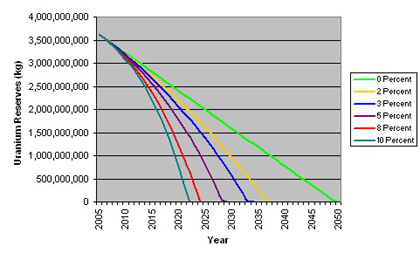
Global Uranium Depletion by Consumption Growth Rates
Even if we maintain current consumption rates, an optimistic reserve of 3.6 billion kg will be depleted by 2050. At two percent growth per year, the uranium will only last until 2037. If the additional uranium in this scenario doesn't materialize, the end will come much sooner.
Proponents of fusion power claim that it will pick up where fission leaves off.
The technical challenges are daunting. The ITER design envisions a toroidal (doughnut-shaped) chamber filled with ionized hydrogen plasma and contained by superconducting magnet coils. When the plasma is compressed until it reaches 100 million degrees Celsius, the hydrogen atoms (mostly deuterium isotopes from oceans plus about 16 kg of tritium, probably supplied by Ontario Power Generation from its CANDU reactors) collide and fuse into helium atoms.
Since a helium atom is slightly less massive than two hydrogen atoms, the excess mass is converted to energy according to Einstein's equation E=mc2. The theory is that fusion reactors based on ITER's design will produce more energy than they consume when they are operated at the optimum scale. Whether this happens remains to be seen.
Maybe nuclear fusion will save us, but don't hold your breath. Even if the ITER experiment in France remains on schedule and is successful (a very big if), it will be at least 50 years before fusion power becomes a viable energy source.
Even in the best case scenario for fission, fusion will probably take several years to ramp up to the output fission currently produces, resulting in yet another gap between the dwindling energy supplies of today and the promised energy supplies of tomorrow.
By Brendan (registered) | Posted July 12, 2005 at 07:42:24
You don't need to worry about "peak-uranium". The industry has already tested thorium fuel, which is three times as abundant.
By David (anonymous) | Posted January 11, 2007 at 12:55:24
Nuclear fuel has two enemies larger than a fuel supply problem. The first is the fear of accidents and the resulting near-end to it's development, and the second is the speed at which peak oil is coming at us verses the slowness of building additional plants. Also, it would take a lot more than a 10% growth in nuclear facilities to replace even a small percentage of the existing fossile plants, which would greatly speed the depletion in the above chart, rendering it a moot point to build them to begin with. Nuclear plants charging electric car batteries won't be the solution.
By Richard (anonymous) | Posted March 14, 2007 at 15:31:29
Wow, could you have made your lies about uranium supply any more blatant? Hmmm, actually probably not.
You must be logged in to comment.
There are no upcoming events right now.
Why not post one?